Absolutism is the political idea that a ruler should hold supreme, undivided power, answerable to no parliament, court or people. It shaped much of Europe between the 16th and 18th centuries, and its most famous embodiment was Louis XIV of France, the “Sun King”.
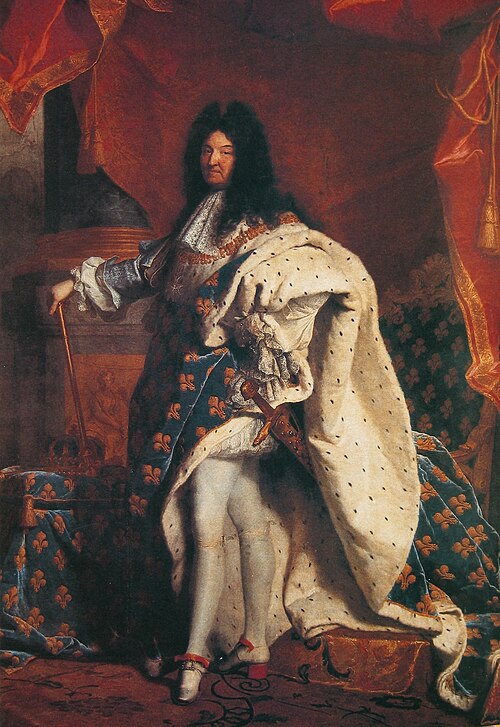 Hyacinthe Rigaud, 1701, Louvre, public domain
Absolutism had several kinds of defenders. The French jurist Jean Bodin, in his Six Books of the Commonwealth (1576), argued that sovereignty is by its nature undivided: a state needs one final authority. Others appealed to the divine right of kings — that monarchs receive their power directly from God and answer to God alone — a view set out by James VI of Scotland (later James I of England) and the French bishop Bossuet.
Thomas Hobbes made the most powerful case without relying on God at all. Without a government, he argued, life would be a war of all against all; rational people would therefore agree to hand almost unlimited power to a sovereign who could keep the peace.
“…and the life of man, solitary, poor, nasty, brutish, and short.”Thomas Hobbes, Leviathan (1651), ch. 13
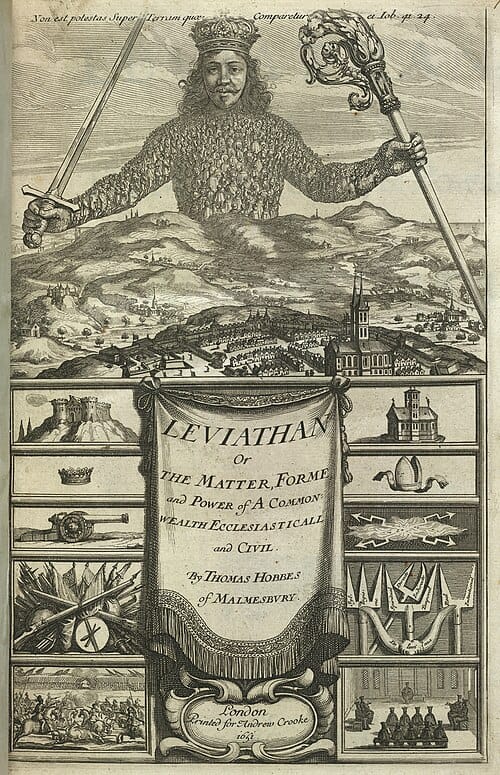 British Library, 1651, public domain
England’s Glorious Revolution of 1688 put limits on the crown, and John Locke’s Two Treatises of Government (1689) argued that government exists to protect people’s rights and may be resisted when it violates them. Montesquieu’s The Spirit of the Laws (1748) called for separating legislative, executive and judicial power. The French Revolution of 1789 swept the old absolutism away, and these ideas went on to shape modern constitutions.
In ethics, “absolutism” means something else: the view that some moral rules hold without exception, whatever the consequences — never torture an innocent, never lie. This moral absolutism, often associated with Kant and with natural-law thinking, is the version set against other schools in the Contradiction Engine: Schools.
 Illustration: one standard over all — political absolutism rests it in a ruler, moral absolutism in unbreakable rules
Absolute monarchy on Wikipedia · Moral absolutism on Wikipedia