Every culture has asked how the world began, and many have wondered whether the question even has an answer. This page follows that question from the hymns of the Rig Veda to the light left over from the Big Bang — and on to our place in the cosmos.
The Rig Veda's Hymn of Creation, more than three thousand years old, begins before there was anything to describe:
“Then was not non-existent nor existent: there was no realm of air, no sky beyond it.”Rig Veda 10.129.1 (tr. Ralph T. H. Griffith, 1896)
It ends with one of the most honest lines in any scripture. Whoever watches over creation from the highest heaven —
“he verily knows it, or perhaps he knows not.”Rig Veda 10.129.7 (tr. Ralph T. H. Griffith, 1896)
Other traditions answered more confidently. Genesis opens: “In the beginning God created the heaven and the earth” (Genesis 1:1, King James Version). Hesiod's Theogony says that first of all came Chaos, the yawning gap. Aristotle, by contrast, argued that the universe had no beginning at all: it is eternal, kept in motion by an “unmoved mover” that moves it as an object of love moves a lover (Metaphysics XII).
 Illustration: the Vedic seers asked their question at the fire altar
In 1714 the German philosopher Leibniz put the question in its sharpest form:
“Why is there something rather than nothing?”Leibniz, Principles of Nature and Grace (1714), §7
Leibniz answered with the principle of sufficient reason: nothing exists without a reason, so the whole chain of things must rest on a necessary being, which he called God. Later philosophers, from Hume to Bertrand Russell, doubted that the universe as a whole needs an explanation at all. Heidegger called Leibniz's question the fundamental question of metaphysics. It has never been settled.
In 1927 the Belgian priest and physicist Georges Lemaître proposed that the universe is expanding from an earlier, denser state, which he later called a “primeval atom”. In 1929 Edwin Hubble showed that distant galaxies are moving away from us, the farther the faster. Run the film backwards and everything converges on a hot, dense beginning about 13.8 billion years ago: the Big Bang.
The strongest evidence arrived by accident. In 1965 Arno Penzias and Robert Wilson found a faint microwave hiss coming from every direction in the sky: light released when the young universe first became transparent, about 380,000 years after the beginning. Satellites have since mapped it in detail.
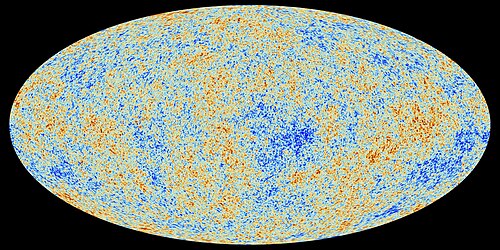
The oldest light in the universe: the cosmic microwave background mapped by the Planck satellite
ESA and the Planck Collaboration, CC BY 4.0
The Big Bang describes how the universe has evolved from its earliest moments. It does not, by itself, say why there was a universe to evolve — which is why Leibniz's question survives the science.
Augustine faced the same puzzle in the 4th century. Asked what God was doing before he made heaven and earth, he reported the joking answer that God was preparing hell for people who pry into such deep matters — and then gave his own: time itself was created with the world, so there was no “before” (Confessions XI). Many cosmologists today say something similar: if time began with the Big Bang, asking what came before may have no meaning. Others explore ideas in which our universe grew out of something earlier.
When a monk named Malunkyaputta demanded to know whether the world is eternal or not, finite or infinite, the Buddha refused to answer. He compared him to a man struck by a poisoned arrow who will not let the doctor remove it until he knows who shot it, what caste he was and what the bow was made of: he would die before learning. The Buddha taught what leads to the end of suffering, and left these questions aside (Cula-Malunkyaputta Sutta, Majjhima Nikaya 63).
Three answers, then, run through the traditions: the world was created, the world is eternal, or the question is not the most important one. You can explore what each implies in Big Questions.
Stanford Encyclopedia: Nothingness · Stanford Encyclopedia: Philosophy of Cosmology · The Hymn of Creation (Nasadiya Sukta) · NASA: Big Bang cosmology