Modern astronomy has made the universe unimaginably larger than our ancestors pictured, and us correspondingly smaller. Philosophers have answered that discovery with dread, with awe and with a strange kind of comfort. This page follows the science and the responses side by side; it continues from Where Did It All Come From?
Our Sun is one of perhaps a hundred billion or more stars in the Milky Way, which is one galaxy among hundreds of billions in the observable universe. Light from the nearest large galaxy, Andromeda, set out about two and a half million years ago.
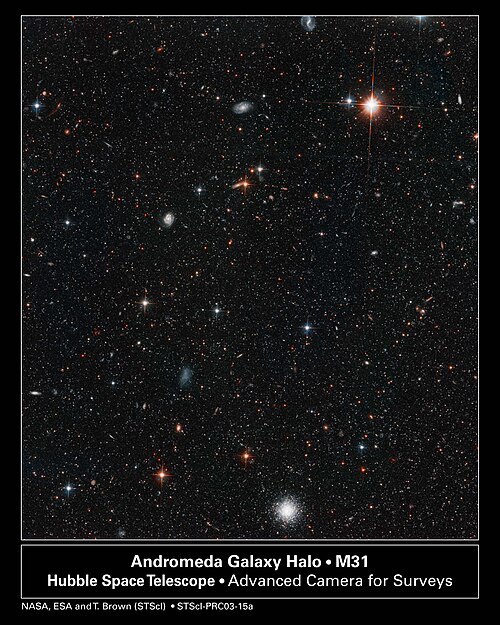
Part of the Andromeda Galaxy, our nearest large neighbour, in a Hubble mosaic
NASA, ESA, J. Dalcanton, B.F. Williams and L.C. Johnson (University of Washington) — public domain
Seventeenth-century Europe was among the first to feel this new vastness, and Pascal recorded his reaction in a single line:
“The eternal silence of these infinite spaces fills me with dread.”Pascal, Pensées 201 (tr. Krailsheimer)
Kant, a century later, looked at the same sky and felt the opposite:
“Two things fill the mind with ever new and increasing admiration and awe: the starry heavens above me and the moral law within me.”Kant, Critique of Practical Reason (1788), Conclusion
The Stoics practised imagining the world from a great height: cities like anthills, wars like squabbles over a little dust, a whole lifetime a moment in endless time. For Marcus Aurelius this was not meant to make life seem pointless, but to shrink petty worries and free attention for what matters (Meditations 9.30, 12.24).
In 1990 the Voyager 1 probe, six billion kilometres away, turned its camera back and photographed Earth as a speck less than a pixel wide. Carl Sagan, who had asked for the picture, wrote of that “pale blue dot”:
“Look again at that dot. That’s here. That’s home. That’s us.”Carl Sagan, Pale Blue Dot (1994)
His conclusion was the Stoics' in modern dress: we should deal more kindly with one another and cherish the only home we have ever known.
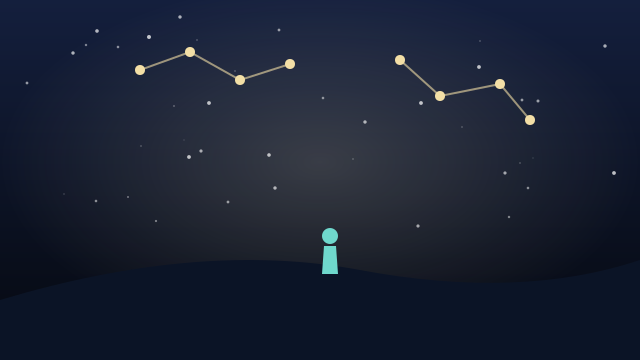 Illustration: the view from above, an old Stoic exercise
Everything we have ever seen — stars, planets, gas, people — makes up only about 5% of the universe. Around 27% appears to be dark matter, which we detect only by its gravity, and around 68% dark energy, which is speeding up the expansion of space. In the Bullet Cluster, two clusters of galaxies collided, and the mass revealed by gravitational lensing (blue) separated from the hot gas we can see (pink): strong evidence that dark matter is real.
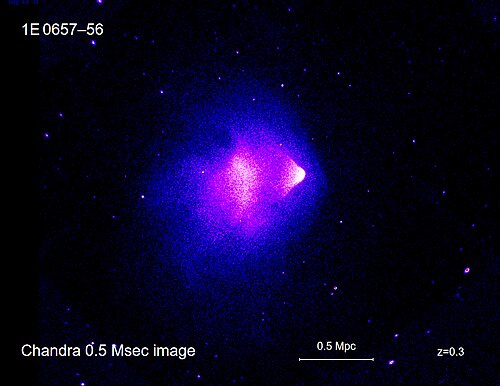
The Bullet Cluster: visible gas (pink) and the hidden mass revealed by gravity (blue)
NASA/CXC/CfA/M. Markevitch et al. (X-ray); NASA/STScI, Magellan/U. Arizona/D. Clowe et al. (lensing map) — public domain
The accelerating expansion was discovered in 1998 by two teams studying distant exploding stars, work that won the 2011 Nobel Prize in Physics. Socrates would have recognised the situation: the more we learn, the clearer it becomes how much we do not know.
A black hole is a region where gravity is so strong that not even light can escape. Its boundary, the event horizon, marks a real limit: nothing that happens inside can ever be reported to the outside. In 2019 the Event Horizon Telescope, a network of radio dishes spanning the Earth, produced the first image of the shadow of a black hole, in the galaxy M87.
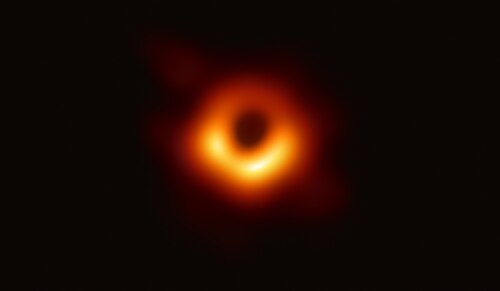
The shadow of the black hole at the centre of galaxy M87, imaged in 2019
Event Horizon Telescope Collaboration, CC BY 4.0
Physics itself, in other words, contains horizons: places that, by their nature, we cannot see past.
Many physical constants seem finely balanced: change the strength of gravity or the mass of certain particles slightly, and stars, chemistry and life could not exist. What does that mean? Some see design. Others appeal to the anthropic principle, named by the physicist Brandon Carter in 1973: we can only ever find ourselves in a universe capable of producing observers. Some cosmologists go further and suggest a multiverse of many universes with different constants, ours being one where life happens to be possible.
Critics reply that other universes can never be observed, so the multiverse may lie beyond science altogether. Karl Popper's test applies: a theory that no observation could ever count against is not, he argued, a scientific theory.
If dark energy keeps driving the expansion, the most likely future is a slow fade: galaxies drift apart, stars burn out, and over unimaginable spans of time the universe cools towards darkness, sometimes called heat death. Bertrand Russell faced that prospect in his essay “A Free Man's Worship” (1903) and concluded that meaning has to be built on facing it honestly, not on denying it.
Indian cosmology imagined time on a similar scale, but as cycles: a single day of Brahma, a kalpa, lasts 4.32 billion years, after which the worlds dissolve and are created again. Whether the universe ends in darkness or in renewal, the traditions agree on one thing: the time we have is short, and worth using well. Memento Mori puts that in numbers.
The Pale Blue Dot photograph · NASA: Dark energy · Event Horizon Telescope · Stanford Encyclopedia: Fine-Tuning