Alchemy is popularly remembered as a failed proto-chemistry, obsessed with turning lead into gold. That reputation captures only its surface. For most of its 2,000-year history, alchemy was practiced as a unified science of matter and spirit, in which the physical transformation of metals in the laboratory was inseparable from the purification of the practitioner's own soul.
Its legendary founder is Hermes Trismegistus ("Thrice-Great Hermes"), a syncretic Greco-Egyptian figure to whom the foundational alchemical and Hermetic texts were attributed — giving alchemy its enduring nickname, the "Hermetic Art."
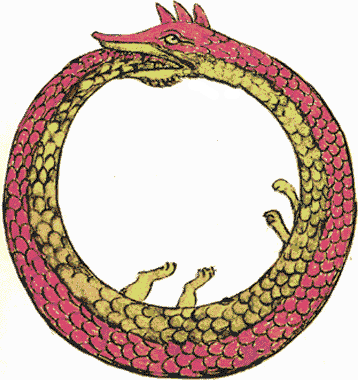 Public domain
Alchemy's earliest documented form emerged in Hellenistic Egypt, particularly Alexandria, around the 1st to 3rd centuries CE, blending Egyptian metallurgical craft with Greek philosophy. It was substantially developed and preserved during the Islamic Golden Age, where scholars such as Jabir ibn Hayyan (Latinized as Geber) systematized laboratory technique and theory — the word "alchemy" itself derives from the Arabic al-kimiya.
Translated into Latin from the 12th century onward, alchemy flourished in medieval and Renaissance Europe, practiced and debated by figures ranging from monks to princes. Even Isaac Newton devoted more manuscript pages to alchemical research than to physics.
The central alchemical project, the Magnum Opus or "Great Work," pursued the Philosopher's Stone — a legendary substance believed capable of transmuting base metals into gold and, in some traditions, granting the elixir of life or immortality.
Spiritually minded alchemists mapped this laboratory process onto stages of inner transformation:
Nigredo ("blackening") — decomposition and confrontation with the practitioner's own shadow and impurities
Albedo ("whitening") — purification, washing away what was dissolved in the first stage
Rubedo ("reddening") — the final union of opposites, completion of the Great Work
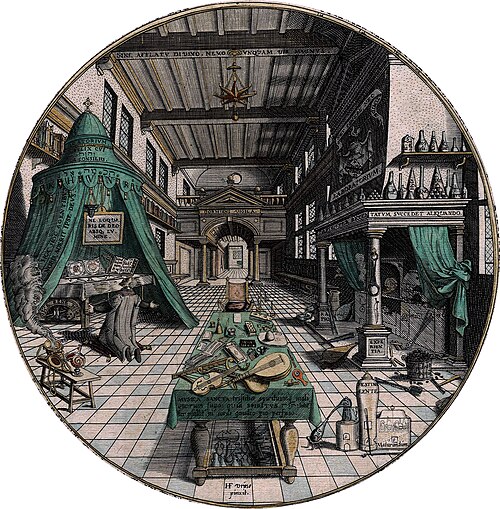 An alchemist's laboratory, 1595 — for many practitioners, transforming base metal into gold was a metaphor for purifying the soul
Read this way, the base metal to be transmuted is the practitioner's own unrefined nature, and gold represents spiritual perfection — a framing that closely parallels the Tantric treatment of the body as raw material for realization.
Alchemy's decline as a mainstream discipline came with the rise of modern chemistry in the 17th and 18th centuries, as figures like Robert Boyle separated rigorous experimental method from alchemy's symbolic and spiritual framework. Its laboratory techniques — distillation, sublimation, calcination — passed directly into chemical science.
Its symbolic half lived on elsewhere: psychologist Carl Jung studied alchemical texts extensively, reading the Great Work as an elaborate historical map of psychological individuation — the integration of the unconscious shadow into a whole self.