The Analects (Lunyu, “Selected Sayings”) is a collection of aphorisms, short conversations and anecdotes of the Chinese teacher Confucius (551–479 BCE) and his disciples. It is not a treatise with an argument but a record of a teacher talking — terse, sometimes cryptic, often humane and surprisingly personal.
“Is it not pleasant to learn with a constant perseverance and application?”Analects 1.1, tr. James Legge
The book opens not with a rule but with the pleasure of learning — a fitting start for the text that became the foundation of East Asian education.
Confucius did not write it. His students, and their students in turn, assembled it over several generations after his death; it probably reached roughly its present form by the Han dynasty (206 BCE–220 CE). Its twenty books differ in style and even in outlook, which shows that layered history.
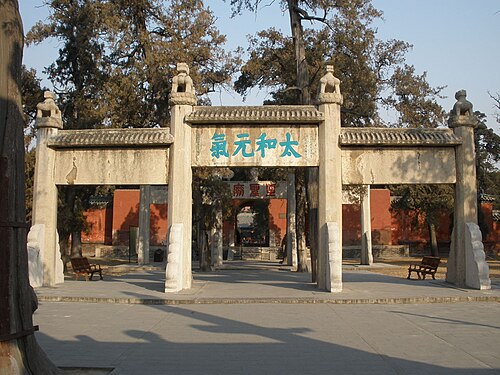 The Temple of Confucius at Qufu, his hometown — Acstar, CC BY-SA 3.0
Ren (仁) — humaneness, the core virtue from which all proper conduct flows
Li (礼) — ritual propriety, the customs that give respectful relationships their shape
Junzi (君子) — the exemplary person, whose character, not birth, earns respect
Xiao (孝) — filial piety, reverence and duty toward parents and ancestors
“What you do not want done to yourself, do not do to others.”Analects 15.23, tr. James Legge
This is Confucius’s version of the Golden Rule, given when a disciple asked for one word to live by. Stated negatively, it stresses restraint and consideration rather than interfering in others’ lives.
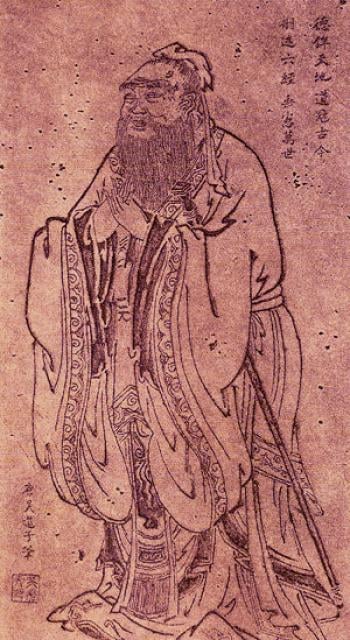 Confucius as traditionally drawn, attributed to Wu Daozi (Tang dynasty) — an imagined likeness, public domain
Because the text is so compressed, translations differ a great deal. James Legge’s Victorian version (1861), used for the quotes on this site, is now in the public domain; later translators such as Arthur Waley, D. C. Lau and Edward Slingerland offer clearer modern English and helpful notes.
From the 14th century until 1905 the Analects, with Zhu Xi’s commentary, was required learning for China’s civil-service examinations, and it shaped education in Korea, Japan and Vietnam too. Its sayings remain part of everyday speech across East Asia.
The Analects on Wikipedia · Confucianism · Confucius: quotes and lessons