Astrology and divination rest on a shared mystical premise: that the cosmos and the self are patterned in ways that can be read, offering guidance or insight beyond ordinary reasoning. The underlying idea is often summarized by the Hermetic phrase "as above, so below" — that the movements of the heavens, the fall of cards, or the cracks in a heated bone all echo the same underlying order that governs human affairs.
Both practices are ancient and remarkably persistent: their popularity has fluctuated for millennia without either ever fully disappearing.
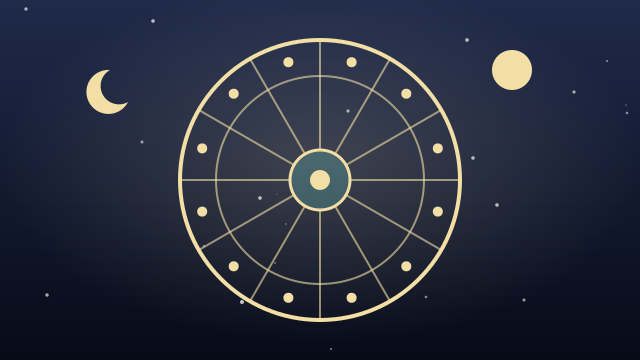 Illustration: the twelve houses of a horoscope wheel
Astrology's earliest developed form arose in Babylonia in the 2nd millennium BCE, where priests correlated planetary movements with omens for the king and state. By the Hellenistic period, following the conquests of Alexander the Great, Babylonian celestial omen-reading fused with Egyptian planetary religion and Greek mathematical astronomy to produce horoscopic astrology — the birth-chart system, tied to the moment and place of an individual's birth, that remains the basis of Western astrology today.
Parallel traditions developed independently: Vedic (Jyotisha) astrology in India, rooted in Vedic ritual timing and later refined with Hellenistic influence, and Chinese astrology, built around a twelve-year animal cycle and the five elements rather than the zodiac's twelve constellations.

A birth chart divides the sky into twelve houses at the moment of birth
Beyond the stars, cultures worldwide developed an enormous range of divinatory techniques for reading hidden order into apparently random events:
Tarot — a deck of 78 illustrated cards, originally a 15th-century Italian card game, adapted for divination from the 18th century onward
I Ching — the ancient Chinese "Book of Changes," consulted by casting yarrow stalks or coins to generate one of 64 hexagrams
Geomancy — divination from patterns of dots or marks, historically widespread from West Africa to the Islamic world to medieval Europe
Scrying — gazing into a reflective or translucent surface, such as a crystal ball or still water, to induce visions
Augury — reading omens from the flight or behavior of birds, central to ancient Roman religious practice
Despite their surface variety, most divinatory systems share a common structure: a randomizing or symbol-generating step (shuffled cards, cast lots, celestial positions) combined with an interpretive framework that assigns meaning to the resulting pattern.
Modern science finds no mechanism by which planetary positions or shuffled cards could influence individual human affairs, and controlled studies have repeatedly failed to find predictive validity in astrology. Critics from antiquity onward — including the Roman skeptic Carneades and, in the Ajivika-adjacent traditions of ancient India, the Carvaka materialists — made similar objections.
Yet the practices endure, and many contemporary practitioners defend them less as literal predictive science than as structured tools for reflection: a horoscope or tarot spread as a prompt for introspection, not a mechanical forecast.
Astrology on Wikipedia · Divination on Wikipedia · Astrology and science on Wikipedia