Simone de Beauvoir was born in Paris on 9 January 1908 into a bourgeois Catholic family whose fortunes declined after the First World War. A devout child, she lost her faith as a teenager and turned to philosophy, studying at the Sorbonne. In 1929, aged twenty-one, she placed second in France’s highly competitive national examination in philosophy, the agrégation — narrowly behind Jean-Paul Sartre, who was taking it for the second time. She was the youngest person ever to pass it.
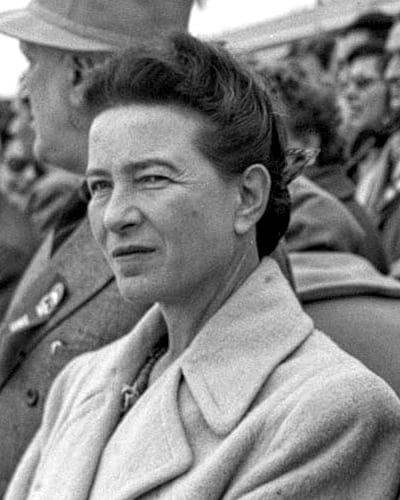 Simone de Beauvoir in Beijing, 1955. Photo: Liu Dong’ao, public domain (source)
That year she and Sartre began a partnership that lasted until his death in 1980. They never married or lived together, agreed that their relationship would be “essential” while others could be “contingent”, and read and criticised everything the other wrote. For decades she was described as Sartre’s companion; scholars now argue that several ideas credited to him were worked out by both, or by her first.
De Beauvoir’s first novel, She Came to Stay (1943), explores freedom and jealousy; The Ethics of Ambiguity (1947) tries to do what Sartre never finished — build an existentialist ethics. Her answer is that freedom cannot be lived alone: to will my own freedom I must also will the freedom of others, since my projects only have meaning in a world shared with them. Oppression, on this view, is not just unjust to its victims; it betrays freedom itself.
Published in 1949, The Second Sex asked why women had been defined throughout history as “the Other” — the second sex, measured against men. Drawing on biology, history, myth and lived experience, she argued that femininity is not a fixed nature but a situation imposed and absorbed: “One is not born, but rather becomes, a woman.” The Vatican placed the book on its Index of Forbidden Books; it went on to become one of the founding texts of second-wave feminism.
Her novel The Mandarins (1954), about postwar Parisian intellectuals, won the Prix Goncourt, France’s top literary prize. She wrote a celebrated four-volume autobiography beginning with Memoirs of a Dutiful Daughter (1958), a moving account of her mother’s death in A Very Easy Death (1964), and a study of ageing, Old Age (1970). In 1971 she signed the “Manifesto of the 343”, in which women declared they had had illegal abortions. She died in Paris on 14 April 1986 and is buried beside Sartre in Montparnasse Cemetery.
Explore more about Simone de Beauvoir on Wikipedia.