The Dhammapada ("Path of the Dharma" or "Verses on the Teaching") is one of the most widely read texts in the Buddhist world — a collection of 423 short verses attributed to the Buddha, arranged into 26 thematic chapters. Part of the Khuddaka Nikaya ("Minor Collection") within the Pali Canon, the scripture of Theravada Buddhism, it distills core Buddhist teaching into memorable, aphoristic form rather than extended philosophical argument.
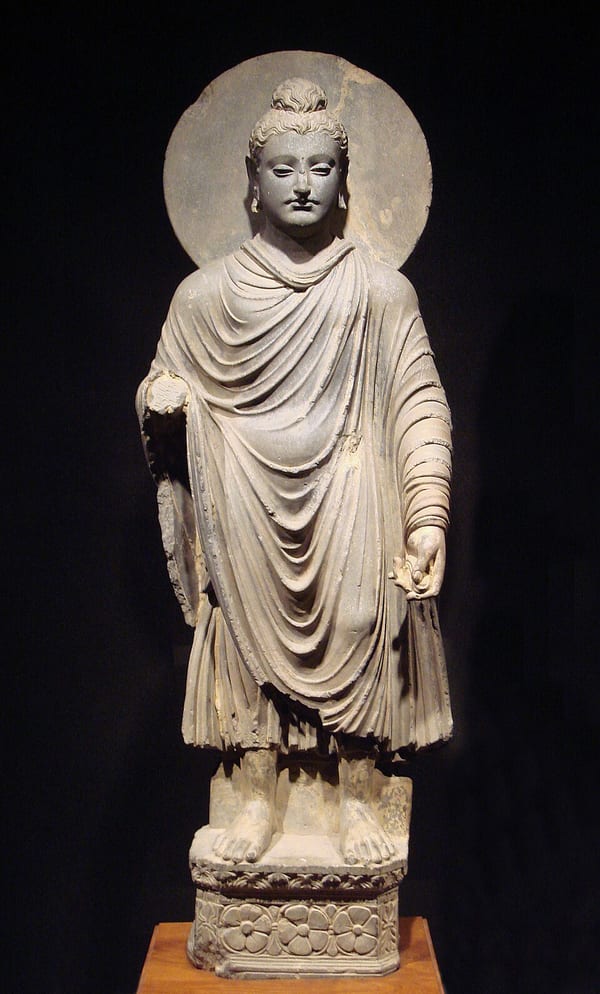 Standing Buddha, Gandhara, 1st–2nd century CE — made centuries after his death; no likeness of the Buddha survives. Tokyo National Museum, public domain (source)
The text opens with its most famous lines, establishing its central premise immediately: "All that we are is the result of what we have thought. It is founded on our thoughts. It is made up of our thoughts. If a man speaks or acts with an evil thought, pain follows him... If a man speaks or acts with a pure thought, happiness follows him."
This opening sets the tone for the whole work: suffering and liberation alike originate in the mind, and disciplined attention to one's own thoughts is both the problem and the path.
Each chapter gathers verses around a specific theme — on vigilance, on the mind, on flowers (a chapter of extended metaphor), on the fool, on the wise, on old age, on the self, on anger, on craving, and, in its most celebrated chapter, on the Brahmana — not referring to caste, but redefining "true nobility" as spiritual attainment rather than birth.
Impermanence — all conditioned things arise and pass away
Karma — ethical cause and effect shaping future experience
Mindfulness — disciplined attention as the foundation of the path
The Eightfold Path — condensed into practical, memorable guidance
Versions of the Dhammapada survive not only in Pali but in Sanskrit, Gandhari (an ancient Indian language preserved on some of the oldest surviving Buddhist manuscripts), and Chinese and Tibetan translation — evidence of the text's early composition and rapid, wide circulation across the Buddhist world as it spread from India along trade routes into Central and East Asia.
Because of its clarity, brevity, and lack of technical philosophical vocabulary, the Dhammapada has long served as many readers' first encounter with Buddhist thought, and it remains among the most frequently translated Buddhist texts into Western languages. Its verses are still recited and memorized by Buddhist practitioners across Theravada traditions in Sri Lanka, Myanmar, Thailand, and beyond.
Structure: 423 verses in 26 chapters
Related Topics: The Eightfold Path, Pali Canon, Theravada Buddhism
Dhammapada on Wikipedia · Dhammapada translation (Access to Insight) · The Buddha