Karl Raimund Popper was born on 28 July 1902 in Vienna, into a highly cultured, prosperous family of Jewish descent that had converted to Christianity. His father was a lawyer with an extensive personal library, and Popper later described his upbringing as intellectually rich but also marked by an early awareness of the social and economic upheaval surrounding post-war Vienna. As a young man he briefly joined a Marxist student group, but grew disillusioned after witnessing what he saw as dogmatic thinking among its members — an experience that planted the seed of his lifelong suspicion of theories that claimed to explain everything and admitted no possible refutation. He studied mathematics, physics, and philosophy at the University of Vienna, where he moved in intellectual circles adjacent to, but critically independent of, the famous Vienna Circle of logical positivists.
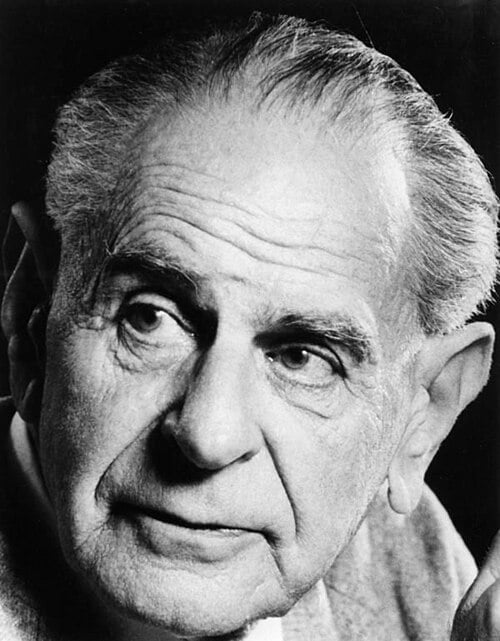 Karl Popper, c. 1980 — LSE Library, no known copyright restrictions
Popper's most influential contribution to philosophy was his proposed solution to the demarcation problem: what distinguishes genuine science from pseudoscience? Where the logical positivists of the Vienna Circle argued that a theory was meaningful only if it could be empirically verified, Popper turned the question around. He observed that theories like Marxism, Freudian psychoanalysis, and Adlerian psychology seemed able to "explain" virtually any observation after the fact, making them unfalsifiable — and, in his view, unscientific for exactly that reason. By contrast, Einstein's general relativity made bold, precise predictions (such as the bending of starlight during a solar eclipse) that could, in principle, have proven it false. Popper proposed that falsifiability — the capacity of a theory to be proven wrong by some conceivable observation — was the true mark of a scientific theory, published in his 1934 work Logik der Forschung (translated into English as The Logic of Scientific Discovery).
 Illustration: no number of white swans proves that all swans are white; one black swan refutes it
Popper extended this idea into a broader philosophy of knowledge he called critical rationalism: since no theory can ever be conclusively proven true through observation alone, science advances not by accumulating confirmations but through a continuous cycle of bold conjecture followed by rigorous attempts at refutation. A theory that survives repeated, serious attempts to falsify it is provisionally retained — not because it has been "proven," but because it has withstood scrutiny better than its rivals. This picture of science as an open-ended process of conjecture and criticism, rather than a march toward certainty, stood in deliberate contrast to both the positivist search for verification and to dogmatic ideologies that treated their core claims as beyond question.
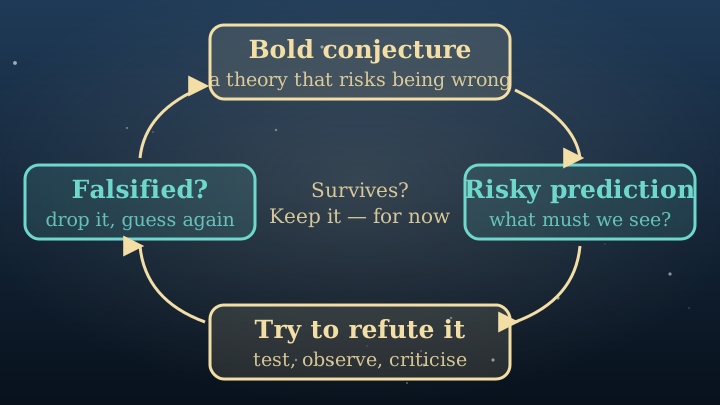 Illustration: science as Popper pictured it — a loop of guesses and attempted refutations, never a final proof
With the rise of Nazism, Popper — of Jewish heritage — emigrated first to New Zealand in 1937, where he took a teaching post and, alarmed by the totalitarianism engulfing Europe, spent the war years writing his other major work, The Open Society and Its Enemies (1945). In it, he traced a lineage of thought from Plato through Hegel to Marx that he argued shared a dangerous feature: the belief that history follows fixed laws leading to a single, knowable ideal society, which in turn justifies imposing that vision by force. Against this "closed society" model, Popper defended an "open society" of liberal democracy, piecemeal social reform, and institutions built to tolerate — even welcome — the constant possibility of being wrong and correcting course.
Key Concepts: falsifiability, demarcation problem, critical rationalism, the open society, piecemeal social engineering
Related Topics: philosophy of science, logical positivism, liberal political theory
In 1946, Popper moved to the London School of Economics, where he held a professorship for decades and was knighted in 1965. His ideas provoked serious debate and refinement from later philosophers of science, notably Thomas Kuhn's account of "paradigm shifts" and Imre Lakatos's "research programmes," both of which challenged aspects of Popper's strict falsificationism while remaining in dialogue with it. He died in London in 1994. Today, "falsifiability" remains one of the most widely cited criteria in discussions of what separates real science from pseudoscience, and his defense of open, self-correcting institutions continues to be invoked in debates over how societies should handle disagreement and change.
Explore more about Karl Popper on Wikipedia.