Banner: the oldest surviving fragment of one of Eckhart’s sermons — Göttingen University, CC BY 3.0. No portrait of Eckhart survives.
Eckhart von Hochheim, known as Meister (Master) Eckhart, was born around 1260 in Thuringia, Germany. He joined the Dominican order, studied and twice held the chair of theology at the University of Paris — a rare honour — and served as a senior official of his order. He wrote learned works in Latin, but he is remembered for his sermons in German, preached to nuns, friars and lay people in Strasbourg and Cologne.
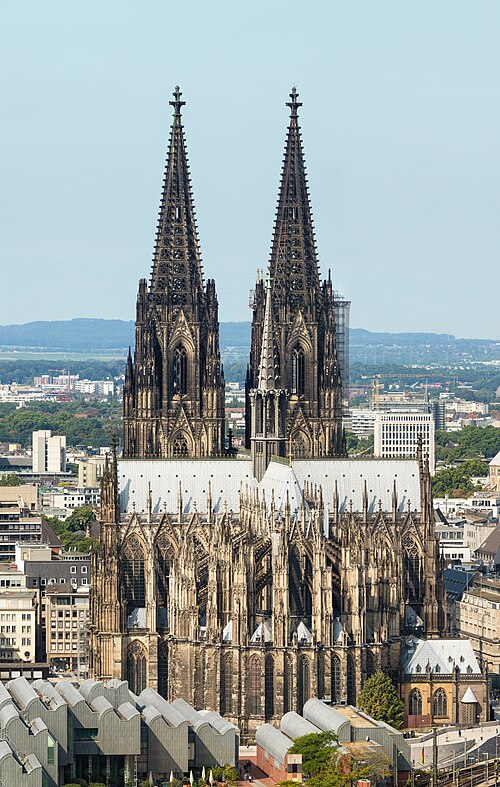 © Thomas Wolf, www.foto-tw.de, CC BY-SA 3.0 DE
“The eye with which I see God is the same eye with which God sees me.”Eckhart, German Sermon 12
Eckhart taught that in the deepest part of the soul — its “ground” — God and the soul are one. Beyond the God of names and attributes lies the “Godhead”, silent and without qualities. To meet God there, a person must let go of every image, even images of God.
Two words sum up his spiritual way: Abgeschiedenheit, detachment, and Gelassenheit, letting-be or releasement. Not cold indifference, but an emptiness of self-will so complete that God can be born in the soul.
Bold sentences like these alarmed the authorities. In 1326 the Archbishop of Cologne opened proceedings against him; Eckhart defended himself and appealed to the pope, but died, probably in 1328, before the verdict. In 1329 a papal bull, In agro dominico, condemned 28 propositions drawn from his work, among them the claim that there is something in the soul uncreated and uncreatable.
Eckhart's favourite theme, preached in a famous series of Christmas sermons, was the birth of God in the soul. The Christmas story, he said, matters little if Christ is born in Bethlehem but not in you. That birth happens in the hidden ground of the soul, in silence, when a person has let go of every image and desire, even the desire for God's gifts.
 Illustration: the ground of the soul, a well where the same water rises
“I have said sometimes that there is a power in the soul untouched by time and flesh.”Meister Eckhart, Sermons
Christian tradition long preferred Mary, who sat at Jesus's feet, to her busy sister Martha, who served in the kitchen. In one of his best-known sermons Eckhart turned this around: Martha, he argued, was the more mature, because she had learned to remain with God while working, whereas Mary was still learning.
 Illustration: Martha’s work and Mary’s prayer, side by side
The same spirit runs through his Talks of Instruction, given to young Dominicans in Erfurt in the 1290s: God is to be found as truly in the stable or the street as in church, and someone who finds God only in quiet places has not really found him. Holiness lies less in what we do than in the spirit in which we do it.
Eckhart urged people to act sunder warumbe, “without a why”: to do good, and even to love God, not for reward, comfort or heaven, but as life simply lives, for its own sake. His Book of Divine Consolation, written for Queen Agnes of Hungary after a series of family deaths, applies this to grief: whoever wants nothing but God's will can be at peace even in loss.
“The most powerful prayer... is that which proceeds from a bare mind... to gain detachment.”Meister Eckhart, On Detachment
“If the only prayer you ever say in your entire life is thank you, it will be enough.” Widely credited to Eckhart, but it has not been found in his sermons or treatises. It reads like a modern paraphrase of his teaching on gratitude.
His disciples Johannes Tauler and Henry Suso carried his teaching on, and later thinkers from Hegel to Heidegger — who borrowed the word Gelassenheit — found him startlingly modern. D. T. Suzuki compared him with Zen masters. Today he is read widely across religious traditions.