Mimamsa means “investigation”. Often called Purva (“prior”) Mimamsa, it studies the earlier, ritual portion of the Vedas, while its sister school, Vedanta (Uttara, “later”, Mimamsa), studies the closing philosophical part, the Upanishads. Its root text is the Mimamsa Sutras of Jaimini, the longest of the darshana sutras, usually placed around the 2nd century BCE. Shabara wrote the classic commentary, and in the 7th century two great interpreters, Kumarila Bhatta and Prabhakara, founded rival sub-schools.
“Now, therefore, the inquiry into dharma.”Mimamsa Sutras 1.1.1
The next sutra defines its subject: dharma is a good that is made known by Vedic injunction. For Mimamsa, dharma is above all duty — what the Veda commands us to do.
Mimamsa’s boldest claim is that the Veda has no author, human or divine (apaurusheya). Words and their meanings, it argued, are eternally connected, and a text no one composed contains none of the errors that authors bring. Strikingly, this led classical Mimamsa to argue against a creator God: the Veda needed no one to write it, and the world needed no one to make it.
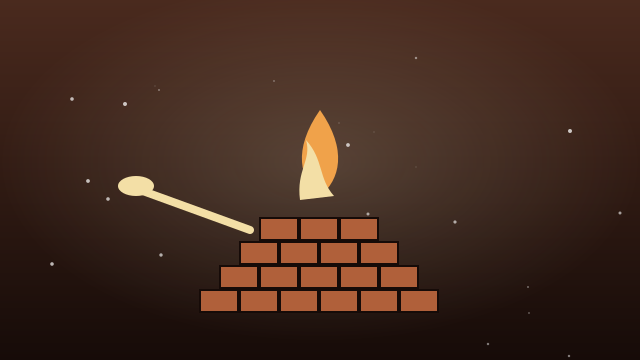 Illustration: a Vedic fire altar — the rituals whose meaning Mimamsa set out to interpret
The school also held that knowledge is valid by default (svatah pramanya): a cognition is accepted as true unless something shows it to be faulty. Doubt needs a reason; belief does not.
A Vedic rite is over in hours, yet its promised fruit, heaven for instance, may come long after death. How can a finished act cause anything? Mimamsa’s answer is apurva, an unseen potency the rite produces in the one who performs it, which persists until it bears fruit.
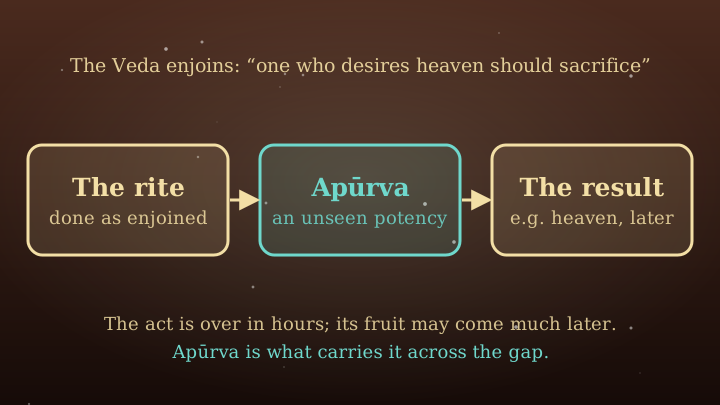 Illustration: apurva bridges the gap between a ritual and its result
Kumarila accepted six means of knowledge, more than any other school: perception, inference, comparison and testimony, plus postulation (arthapatti) and non-apprehension (anupalabdhi). The classic example of postulation: Devadatta is fat but never eats by day — so he must eat at night. Prabhakara accepted five, rejecting non-apprehension. Advaita Vedanta later adopted Kumarila’s list of six.
Legacy in law: Mimamsa developed detailed rules for reading a text — how to resolve apparent contradictions, when a word is literal, what to do when two rules collide. These maxims (nyayas) became the standard method for interpreting the Dharmashastras, the classical Hindu law books, and Indian legal scholars still cite them.
Mimamsa on Wikipedia · Kumarila Bhatta on Wikipedia · Stanford Encyclopedia: Epistemology in Classical Indian Philosophy