Ramakrishna was born Gadadhar Chattopadhyay on 18 February 1836 in Kamarpukur, a village in Bengal, into a poor Brahmin family. He had little schooling but a deep love of devotional songs, drama and the religious life of the village, and from childhood he had spells of spiritual ecstasy.
In the mid-1850s he became a priest at the new Kali temple at Dakshineswar, near Calcutta. His longing to see the Divine Mother was so intense that people thought him mad; he described visions of Kali as a living, loving mother. In 1859 he married Sarada Devi, later revered in her own right as the Holy Mother.
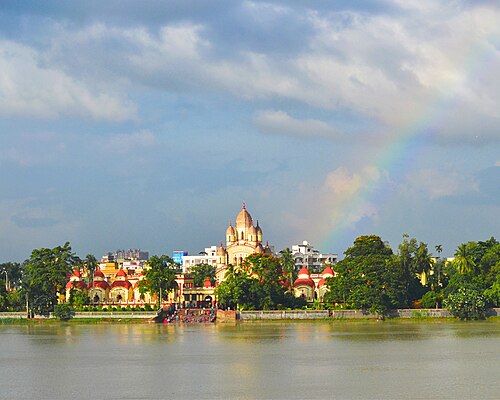 Provatkrmukherjee, CC BY-SA 4.0
“As many faiths, so many paths.”Ramakrishna, as recorded in The Gospel of Sri Ramakrishna
Ramakrishna practised one path after another under different teachers — Tantra with the Bhairavi Brahmani, Advaita Vedanta with the monk Totapuri — and, by the accounts of his disciples, Islamic and Christian devotion too. He concluded that every sincere path leads to the same God, just as many ghats lead down to the same water.
He taught through simple, vivid parables: a salt doll that went to measure the depth of the ocean and dissolved; a roof that can be reached by ladder, stairs, bamboo or rope.
Educated young men of Calcutta began to visit him, among them Narendranath Datta, who would become Swami Vivekananda. One devotee, Mahendranath Gupta, known as “M”, wrote down his conversations in detail; they were published as the Sri Sri Ramakrishna Kathamrita, translated into English as The Gospel of Sri Ramakrishna. Ramakrishna died of throat cancer on 16 August 1886.
Ramakrishna's life at Dakshineswar was an experiment carried out on himself. After his first overwhelming vision of Kali, said to have come when, in despair, he reached for the sword in the temple, he spent roughly twelve years trying one spiritual discipline after another. His disciples' accounts describe each in turn: the tantric rites taught by the Bhairavi Brahmani; the devotional moods of Vaishnava practice, in which he related to God as a servant, a friend, a parent and a lover; formless meditation with the Advaita monk Totapuri; and, briefly, the prayers of Islam and a vision of Christ.
Each time, he reported, the path ended in the same realisation. That experience, rather than any theory, is the source of his teaching that the religions are different roads to one God.
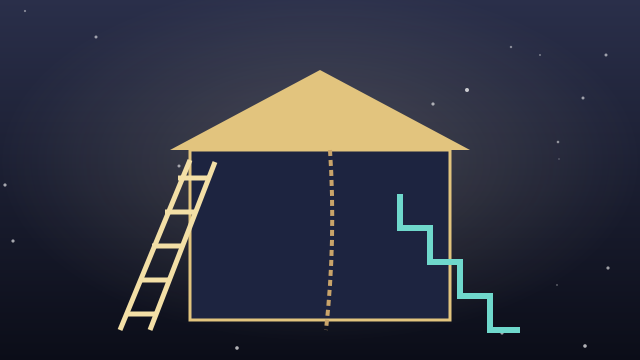 Illustration: one roof, reached by ladder, stairs, bamboo or rope
“As one can ascend to the top of a house by means of a ladder or a bamboo... so diverse are the ways to reach God.”Ramakrishna, The Gospel of Sri Ramakrishna
Ramakrishna was not a scholar and did not write. He taught in Bengali village speech, through stories drawn from farming, fishing and the household, and he had little patience for learning that did not change how a person lived. A pandit who could quote scripture but still craved money and fame was, he said, like a vulture soaring high in the sky with its eyes fixed on a rotting carcass below.
His warnings centred on two snares he called kamini-kanchana, usually translated “woman and gold”, addressed to his young male disciples and meaning lust and greed. Against them he set longing: a devotee should cry for God as a drowning man gasps for air.
 Illustration: the salt doll that went to measure the ocean
“A salt doll went to measure the depth of the ocean... it dissolved.”Ramakrishna, The Gospel of Sri Ramakrishna
The salt doll is his picture of the deepest experience of God: whoever goes all the way in cannot come back to describe it, because there is no longer a separate “someone” to report.
Ramakrishna's marriage to Sarada Devi (1853–1920) was arranged in 1859, when she was a small child, as was common then. She joined him at Dakshineswar as a young woman in 1872, and in a ritual that year he worshipped her as the Divine Mother herself. Their marriage remained celibate. After his death she guided his young monks with practical warmth, and she is revered today as the Holy Mother, a teacher in her own right.
Ramakrishna became known beyond the temple in the 1870s, when the reformer Keshab Chandra Sen of the Brahmo Samaj began writing about him. Through Keshab, the educated youth of Calcutta, Narendranath among them, found their way to Dakshineswar.
In 1897 Vivekananda founded the Ramakrishna Mission, which still runs schools, hospitals and relief work. Ramakrishna’s message — that all religions are paths to one truth — became one of the most influential ideas of modern Hinduism.