Samkhya (“enumeration”) may be the oldest of the darshanas. Tradition names the sage Kapila as its founder, and its ideas run through the Upanishads, the Mahabharata and the Bhagavad Gita. The oldest surviving textbook of the school, though, is much later: the Samkhya Karika of Ishvarakrishna, a compact work of about seventy verses usually dated to around the 4th or 5th century CE.
“From the torment of threefold suffering arises the desire to know the means of removing it.”Samkhya Karika 1
The three sufferings are those that come from within (illness, grief), from other beings, and from nature and fate. Samkhya is, from its first line, a cure.
Samkhya divides everything into two utterly different kinds of reality:
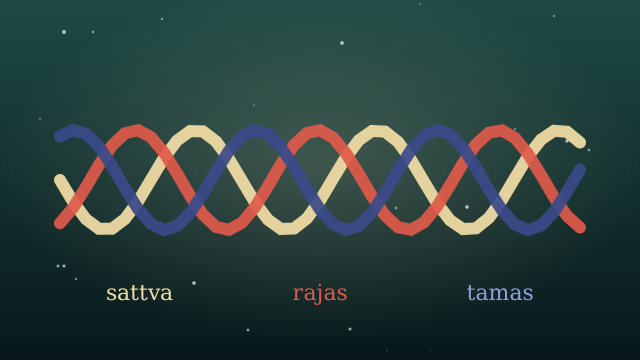 Illustration: the three gunas braided into one strand of nature
The surprise for modern readers is where the line falls. Intellect, ego and mind all sit on the matter side. Thinking, choosing and feeling “I” are processes of nature; only the bare light of awareness that witnesses them is spirit.
In the presence of purusha, the balance of prakriti’s three gunas is disturbed and the world unfolds in stages: first intellect (buddhi), then the sense of “I” (ahamkara), then mind, the five senses, the five organs of action, the five subtle elements, and finally the five gross elements of earth, water, fire, air and ether. Counted with purusha and prakriti, that makes twenty-five tattvas — the enumeration that gives the school its name.
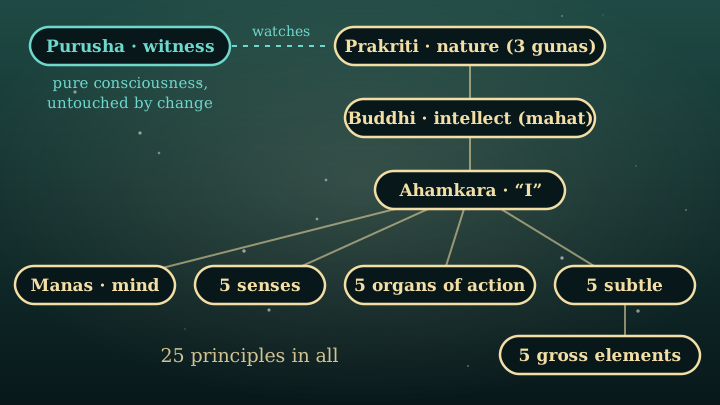 Illustration: the 25 tattvas — purusha watches as prakriti unfolds
Samkhya also held that an effect already exists, in hidden form, in its cause (satkaryavada), much as a pot is already latent in the clay. Creation is unfolding, not making something from nothing.
Suffering comes from confusion: purusha mistakes the movements of prakriti for its own. Liberation, kaivalya (“aloneness”), is the discriminating insight that the witness was never the thing witnessed. The Karika (verse 59) compares prakriti to a dancer who stops dancing once she has been fully seen.
No creator God: Classical Samkhya explains the world without a God. Its sister school, Yoga, accepted its whole map of reality but added Ishvara as a special purusha, and turned the insight into a practical method of stilling the mind.