Vaisheshika takes its name from vishesha, “particularity” — the feature that makes each ultimate thing distinct from every other. Its founding text, the Vaisheshika Sutra, is attributed to a sage called Kanada, a name that fittingly means something like “atom-eater”. Its date is uncertain; scholars place it in the last centuries BCE. The system was given its classic shape around the 6th century CE by Prashastapada.
“Now, therefore, we shall explain dharma.”Vaisheshika Sutra 1.1.1
It is a surprising opening for a book about atoms. The next sutra explains: dharma is that from which comes both prosperity and the highest good. For Kanada, understanding what the world is truly made of was itself part of the path to liberation.
Vaisheshika’s great project is a complete inventory of reality. Everything that can be known and named falls into one of six categories (padarthas):
Later writers added a seventh: absence (abhava) — the “no pot on the table” that you can also perceive.
There are nine substances: earth, water, fire, air, ether (akasha), time, space, self and mind.
The first four substances are made of atoms (paramanus): eternal, partless and too small to see. Two atoms join to form a dyad; three dyads form a triad, which was said to be the smallest visible thing — a speck of dust in a sunbeam. Larger things are built from there, and dissolve back into atoms at the end of each cosmic cycle.
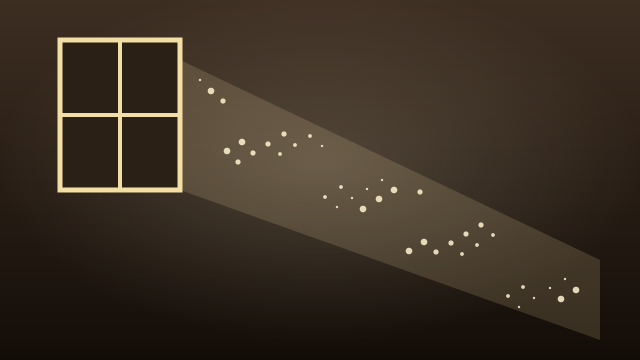 Illustration: motes in a sunbeam — the smallest visible things, built from atoms
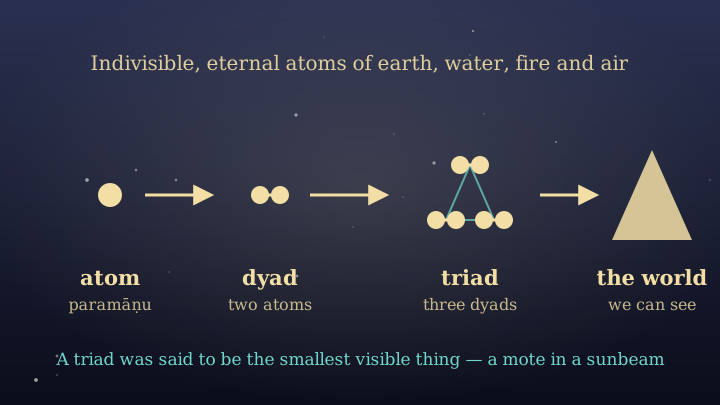 Illustration: how Vaisheshika builds the visible world from atoms
What sets atoms moving when a new world begins? Kanada pointed to adrishta, the “unseen” force of beings’ past actions. Later Nyaya-Vaisheshika thinkers added the will of God.
Compared with Greek atomism: Democritus also taught indivisible atoms, but his moved randomly in a void and needed no moral force behind them. Vaisheshika’s atoms are qualitatively different from each other (earth atoms, water atoms...) and their motion is tied to karma. The two traditions appear to have developed independently.
Vaisheshika accepts only two means of knowledge, perception and inference. In time it merged with Nyaya into one system, Nyaya-Vaisheshika, in which Vaisheshika provided the map of what exists and Nyaya the theory of how we come to know it.