Modern Paganism (or Neopaganism) is an umbrella term for contemporary religious movements that draw on pre-Christian, nature-venerating traditions of Europe and beyond. Wicca, its best-known and most influential branch, is a specific initiatory tradition formalized in mid-20th-century England — not a direct, unbroken survival of ancient paganism, despite sometimes being popularly framed that way.
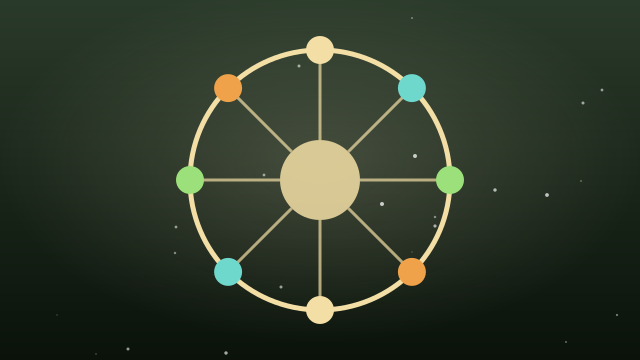 Illustration: the Wheel of the Year and its eight festivals
Wicca emerged publicly in England in the 1950s through Gerald Gardner, a retired civil servant and amateur folklorist who claimed to have been initiated into a surviving hereditary witchcraft coven in the New Forest in 1939. Historians generally regard Wicca as a genuinely new synthesis rather than an unbroken ancient lineage — drawing on the 19th- and early 20th-century occult revival, Freemasonry, ceremonial magic (Gardner was briefly associated with Aleister Crowley's circle), and Margaret Murray's since-discredited theory of a surviving pan-European "witch-cult."
Gardner's 1954 book Witchcraft Today and the tradition he founded, later called Gardnerian Wicca, spread rapidly, spawning numerous related traditions — Alexandrian Wicca, Dianic Wicca, and many eclectic, self-initiated forms — over the following decades.
Wiccan theology typically centers on a polarity of divine feminine and masculine, embodied as a Goddess (often connected to the moon and the triple Maiden-Mother-Crone archetype) and a Horned God (connected to nature, the hunt, and the cycle of the seasons). Practice follows the Wheel of the Year, eight seasonal festivals or sabbats spaced roughly six weeks apart, marking solstices, equinoxes, and the midpoints between them.

The pentagram within a circle, often flanked by lunar symbols, is Wicca's most recognizable emblem
Ritual work — casting a circle, invoking the God and Goddess, spellcraft, and seasonal celebration — is usually conducted either solitarily or within small groups called covens. Ethical practice is commonly guided by the Wiccan Rede, most often summarized as "An it harm none, do what ye will," alongside the Threefold Law, the belief that whatever energy a practitioner sends out returns to them amplified.
Wicca is only one current within a much broader modern Pagan movement, which also includes reconstructionist traditions that attempt to rebuild specific historical practices from surviving evidence — such as Ásatrú (Norse), Hellenism (Greek), and Kemetism (Egyptian) — as well as Druidry, which draws on (heavily reinterpreted) Celtic tradition. These traditions vary widely in how strictly they hew to historical reconstruction versus eclectic, modern synthesis, and many Pagans practice outside any formal tradition at all.
Key Figures: Gerald Gardner, Doreen Valiente, Alex Sanders
Core Elements: The Wheel of the Year, the Wiccan Rede, the God and Goddess, ritual magic
Related Traditions: Druidry, Ásatrú, Hellenism, Kemetism
Wicca on Wikipedia · Modern paganism on Wikipedia · Britannica: Wicca