Paramahansa Yogananda was born Mukunda Lal Ghosh on 5 January 1893 in Gorakhpur, in northern India, into a devout Bengali family. As a young man he searched for a teacher and found one in Swami Sri Yukteswar Giri of Serampore, with whom he trained for some ten years. In 1915 he took monastic vows and the name Yogananda, “bliss through yoga”.
In 1917 he founded a school for boys in Ranchi, and in 1920 he travelled to the United States to speak at the International Congress of Religious Liberals in Boston. He stayed for most of the rest of his life, founding the Self-Realization Fellowship that year and teaching to large audiences across the country. In 1935–36 he returned to India, where he met Mahatma Gandhi and taught him Kriya Yoga. He died in Los Angeles on 7 March 1952.
“Kriya Yoga is an instrument through which human evolution can be quickened.”Yogananda, Autobiography of a Yogi, ch. 26
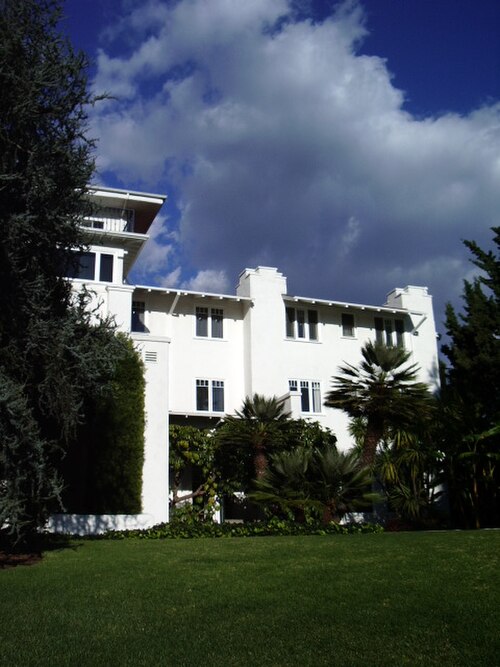 Jack B108, CC BY-SA 3.0
Published in 1946, Autobiography of a Yogi introduced millions of readers to yoga, meditation and Indian saints. It remains in print around the world; Steve Jobs reportedly reread it every year, and copies were handed out at his memorial in 2011.
Yogananda placed himself in a chain of masters that he describes in Autobiography of a Yogi. At its head stands Mahavatar Babaji, a deathless Himalayan yogi known only through the accounts of his disciples. Babaji, Yogananda writes, revived Kriya Yoga in 1861 and gave it to Lahiri Mahasaya (1828–1895), a householder and government accountant in Varanasi, who insisted that the highest yoga could be practised by people with jobs and families.
Lahiri Mahasaya's disciple Sri Yukteswar (1855–1936), who taught in Serampore and Puri, was a stern, astrologically minded teacher and the author of The Holy Science (1894), comparing the Bible and Hindu scripture. Yogananda's affectionate portrait of him is one of the most vivid parts of the Autobiography.
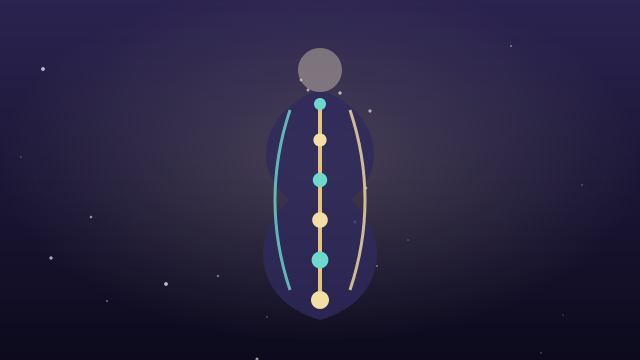 Illustration: Kriya Yoga draws breath and attention along the spine
Kriya Yoga combines breath control, meditation and devotion. In Yogananda's description, the practitioner mentally guides life-energy up and down the spine, calming breath and heart so that attention can turn fully inward. He compared one round of Kriya to a year of natural spiritual growth, and taught that regular practice could hasten a soul's evolution.
The technique itself is taught only after preparation. Since the 1920s the Self-Realization Fellowship has sent its students a course of printed lessons, leading through simpler concentration and energy exercises before initiation into Kriya. Yogananda stressed that the method works only with steady, patient practice.
“Adamant patience... is necessary if you would rise quickly.”Yogananda, Autobiography of a Yogi
From his headquarters on Mount Washington in Los Angeles, bought in 1925, Yogananda set out to show that the core of the Gospels and the Bhagavad Gita was the same: direct, inner experience of God. His long verse-by-verse commentaries on both were published after his death, as God Talks with Arjuna (1995) and The Second Coming of Christ (2004). He dressed his teaching in the language of science and practical self-improvement that suited his American audiences, and wrote widely about diet, health and success as well as meditation.
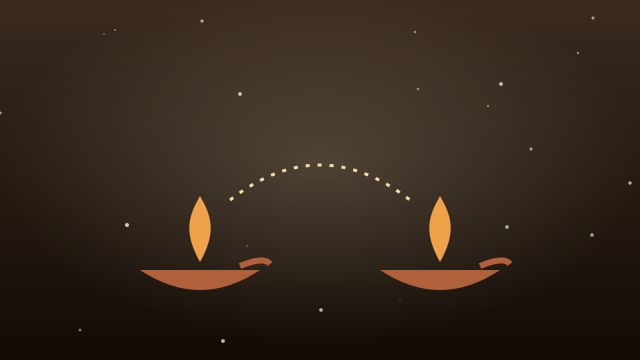 Illustration: one flame passed between two lamps, East and West
“The season of failure is the best time for sowing the seeds of success.”Yogananda, Autobiography of a Yogi
After his death in 1952, his organisation published a letter from the director of Forest Lawn mortuary saying his body showed no visible signs of decay for twenty days. His followers see this as a sign of his spiritual attainment; sceptics are less sure what to make of it.
Yogananda was among the first Indian teachers to live and teach in the West for decades, and he helped make meditation part of ordinary Western life. His organisations — the Self-Realization Fellowship and, in India, the Yogoda Satsanga Society — continue his work.