Banner: a modern sculpture of Chanakya with Chandragupta Maurya (CC0) — no likeness of Chanakya survives.
Chanakya — also known as Kautilya or Vishnugupta — was born around 375 BCE, most traditions place his upbringing near Takshashila (Taxila), then one of the great centers of learning in the ancient world. He studied and later taught there, specializing in politics, economics, law, and military strategy, and was known even in his own time for a sharp intellect paired with an uncompromising, occasionally abrasive personality. According to tradition, he was publicly humiliated at the court of the Nanda king Dhana Nanda — an insult he is said to have vowed to avenge, setting in motion the political career for which he's remembered.
Chanakya discovered and mentored a young Chandragupta Maurya, guiding him strategically, militarily, and politically in a campaign that overthrew the Nanda dynasty around 321 BCE and established the Maurya Empire — which, at its height under Chandragupta's grandson Ashoka, became one of the largest empires in ancient Indian history. Chanakya went on to serve as chief advisor to Chandragupta and, by most accounts, to his son Bindusara as well, effectively functioning as the empire's chief strategist across two reigns.
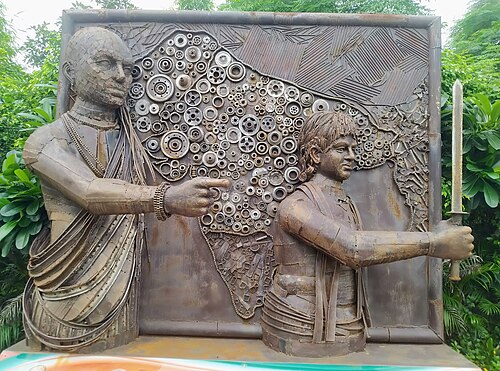 Public domain (CC0)
Chanakya authored the Arthashastra ("The Science of Material Gain," or of statecraft), a comprehensive treatise covering governance, law, taxation, trade, military strategy, foreign policy, and espionage — often compared to Machiavelli's The Prince, written roughly 1,800 years later, for its unsentimental realpolitik. Among its most distinctive ideas is the "Mandala theory" of foreign policy, which maps a kingdom's neighbors and their neighbors as concentric circles of likely allies and rivals, and the fourfold strategy of Saam, Daam, Dand, Bhed — persuasion, incentive, punishment, and division — as the tools available to any ruler dealing with a rival power.
 Oriental Research Institute, Mysore, public domain
Chanakya is widely regarded as the father of political science and economics in the Indian tradition, and the Arthashastra remains one of the most studied texts on statecraft to survive from the ancient world, alongside works like Sun Tzu's The Art of War. His shorter aphoristic text, the Chanakya Niti, is still read today as practical folk wisdom on ambition, relationships, and self-discipline, and his ideas are frequently taught in Indian business and management education as an early model of strategic thinking.
Explore more about Chanakya on Wikipedia.
Read Chanakya's Famous Quotes & Lessons →