Banner: Confucius as traditionally drawn, attributed to Wu Daozi (Tang dynasty) — an imagined likeness; no portrait from life survives.
Confucius (Kong Qiu, later honored as Kongzi, "Master Kong") was born around 551 BCE in the state of Lu, in what is now Shandong province, China. He lost his father while still young and was raised in modest circumstances, working a series of minor government posts before turning to teaching. In a notable break from tradition, he accepted students regardless of their social class, believing that moral cultivation — not birth — was what qualified someone for a life of virtue and service. He briefly held government office in Lu but resigned amid political disillusionment, spending roughly fourteen years traveling between rival states, offering counsel to rulers who rarely acted on it, before returning home late in life to teach and to edit the classical texts of his tradition. He died in 479 BCE.
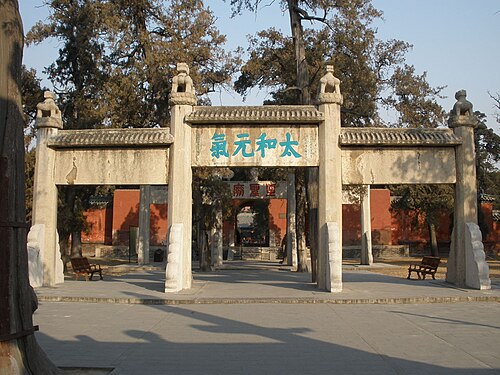 Acstar, CC BY-SA 3.0
At the center of Confucius's teaching is ren — usually translated as benevolence, humaneness, or human-heartedness — the underlying virtue that makes all other virtues meaningful. He paired this with li, ritual propriety: the web of social customs, courtesies, and ceremonies that, practiced sincerely, express and reinforce genuine moral character rather than merely enforcing conformity. Filial piety (xiao) — respect and care for one's parents and elders — was, for Confucius, the training ground where these virtues are first learned. He also taught the "rectification of names": that social harmony depends on people and roles actually living up to what they are called (a ruler truly ruling well, a parent truly parenting well), and offered his own version of the Golden Rule: "Do not impose on others what you yourself do not desire."
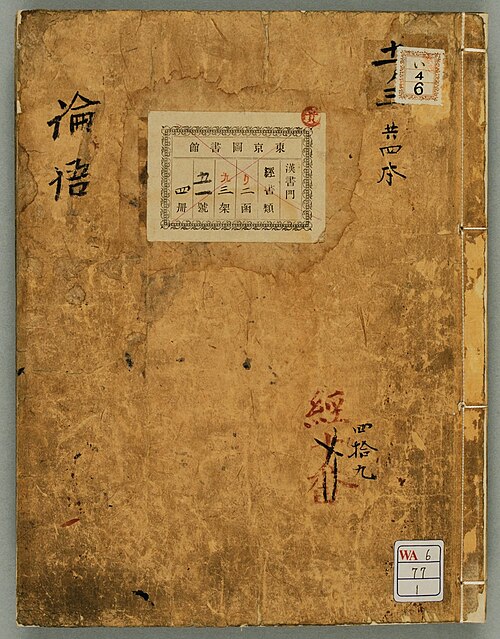 National Diet Library / World Digital Library, public domain
Confucius's teachings shaped Chinese civilization for over two thousand years. Confucianism became the official state ideology under the Han dynasty and, for centuries afterward, formed the basis of the imperial civil service examinations that determined who could hold government office across China. His influence spread throughout East Asia, shaping family structure, education, and governance in Korea, Japan, and Vietnam as well as China. Centuries later, Neo-Confucian scholars reinterpreted and revived his ideas, and Confucian ethics continue to inform social and political thought across East Asia today.
Explore more about Confucius on Wikipedia.
Read Confucius' Famous Quotes & Lessons →