Marcus Aurelius was born Marcus Annius Verus on 26 April 121 CE in Rome, into a wealthy and politically prominent family with strong connections to the imperial court. His father died when Marcus was a young child, and he was largely raised by his grandfather and, later, his mother Domitia Lucilla, a woman of considerable inherited wealth. Even as a boy, Marcus was noted for his seriousness and diligence — the emperor Hadrian is said to have nicknamed him "Verissimus" ("most truthful") as a playful twist on his family name, Verus. From around age twelve, Marcus adopted the simple cloak of a philosophy student and briefly practiced sleeping on the ground, an early sign of the ascetic, self-disciplined temperament that would define his later life.
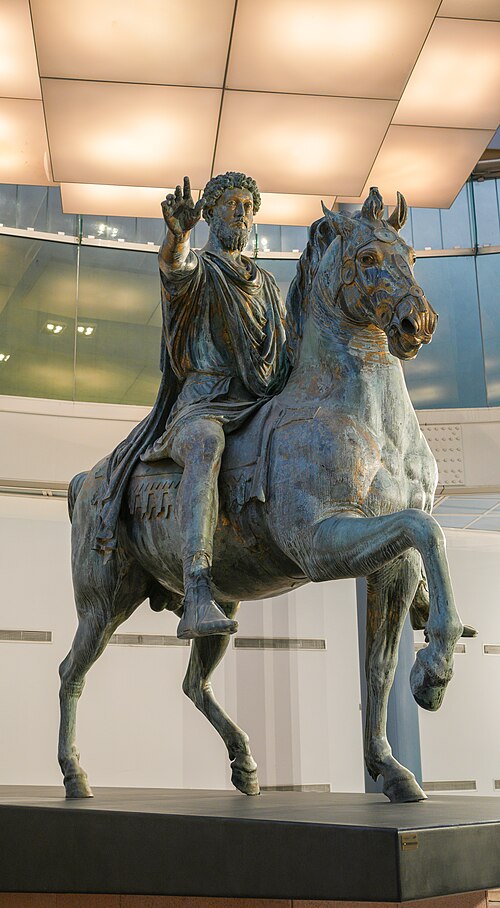 Merulana, CC BY-SA 4.0
In 138 CE, the aging and childless Emperor Hadrian arranged an unusual chain of succession: he adopted Antoninus Pius as his heir, on the condition that Antoninus in turn adopt both the teenage Marcus and another young relative, Lucius Verus. This arrangement was designed to secure the empire's leadership two generations ahead. Marcus spent the next twenty-three years as Antoninus's designated successor, marrying the emperor's daughter Faustina the Younger and gradually taking on public responsibilities. When Antoninus died in 161 CE, Marcus insisted — against precedent — that Lucius Verus be made co-emperor alongside him rather than a mere subordinate, resulting in Rome's first experiment with two emperors ruling jointly with roughly equal authority.
Marcus Aurelius is best remembered today for Meditations, a collection of private philosophical notes he wrote in Greek, largely during military campaigns on the empire's northern frontier late in his life. He never intended the work for publication — it reads as a series of reminders he wrote to himself, urging himself back toward Stoic discipline amid the exhaustion of constant warfare and administration. His teacher Junius Rusticus introduced him to the writings of the Stoic philosopher Epictetus, whose teachings on distinguishing what is and isn't within one's control became the philosophical backbone of Meditations. Recurring themes include the impermanence of fame and life, the discipline of perceiving events without added judgment, and the duty to act justly regardless of how others behave.
What makes Marcus Aurelius unusual among ancient rulers is how directly his private philosophy shaped his public conduct. He was known for personally reviewing petitions and legal cases with unusual patience, for expanding legal protections for slaves, orphans, and widows, and for funding the raising of orphaned children. When his trusted general Avidius Cassius revolted and declared himself emperor in 175 CE — prematurely believing a false report of Marcus's death — Marcus reportedly expressed regret that Cassius was killed before he had the chance to forgive him in person, and had the general's co-conspirators pardoned rather than executed. Whether or not every anecdote is precisely accurate, they reflect a consistent ancient reputation for restraint that stood in sharp contrast to many of his imperial predecessors.
Marcus's reign was tested repeatedly by crisis. Returning Roman troops brought back what became known as the Antonine Plague around 165 CE, a devastating epidemic (likely smallpox or measles) that killed millions across the empire over the following years, reportedly including his own co-emperor Lucius Verus in 169 CE. At the same time, Rome fought a prolonged, grinding conflict against the Parthian Empire in the east, and — for most of the 160s and 170s — the exhausting Marcomannic Wars against Germanic tribes pressing on the empire's Danube frontier, campaigns that occupied much of Marcus's later reign and provided the setting in which he wrote most of Meditations. Financial strain from war and plague reportedly led him to auction off imperial palace treasures rather than raise taxes further on an already-suffering population.
Marcus Aurelius died in 180 CE at Vindobona (modern Vienna), likely while still on campaign against Germanic tribes. His reign is traditionally counted as the last of the "Five Good Emperors," a run of relatively stable, competent rule; his choice to let his own son Commodus succeed him — breaking with the adoptive-succession pattern that had worked so well for his predecessors — is often cited by later historians as marking the beginning of Rome's slow imperial decline, since Commodus's chaotic reign fell far short of his father's. Meditations itself survived only through a handful of manuscript copies and was largely unknown in the West until the Renaissance; it has since become one of the most widely read works of ancient philosophy, and its central ideas underpin much of the modern Stoicism revival in psychology, self-help, and resilience training.
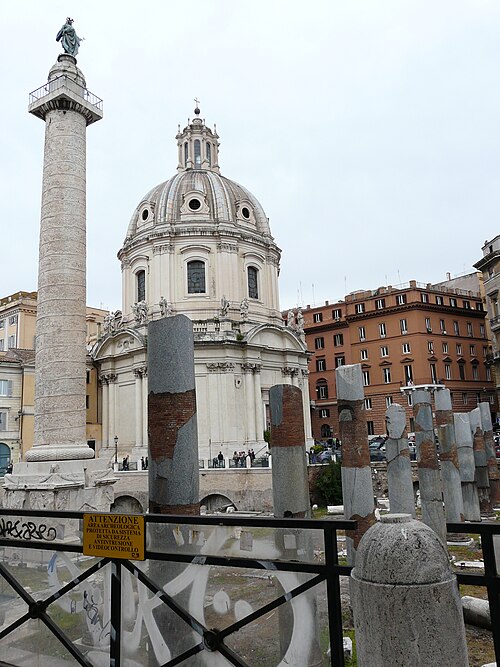 l0da_ralta, CC BY 2.0
Explore more about Marcus Aurelius on Wikipedia.
Read Marcus Aurelius' Famous Quotes & Lessons →