Nietzsche wrote in German and in deliberately provocative fragments; the translations below follow the standard English editions. Read in context, several of his most famous lines mean something quite different from their poster versions.
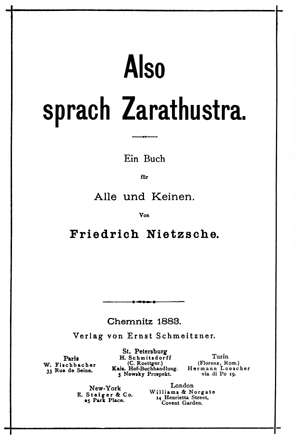 First edition cover, 1883, public domain
“What does not kill me makes me stronger.”Twilight of the Idols (1888), “Maxims and Arrows” 8
Hardship survived can become strength — a claim about what the will can do, not a promise that suffering is good.
“If we have our own why in life, we shall get along with almost any how.”Twilight of the Idols, “Maxims and Arrows” 12
Purpose makes almost any hardship bearable.
“Without music, life would be a mistake.”Twilight of the Idols, “Maxims and Arrows” 33
For Nietzsche, art is not decoration; it is what makes life worth affirming.
“God is dead. God remains dead. And we have killed him.”The Gay Science (1882), §125
Not a celebration but an alarm: what fills the space once shared meaning collapses?
“What does your conscience say? — “You shall become the person you are.””The Gay Science, §270
The task of a life is to grow into your own nature, not someone else’s.
“Whoever fights monsters should see to it that in the process he does not become a monster. And if you gaze long into an abyss, the abyss also gazes into you.”Beyond Good and Evil (1886), §146
What you oppose for long enough can start to shape you.
“One must still have chaos in oneself to be able to give birth to a dancing star.”Thus Spoke Zarathustra, Prologue §5
Inner turbulence is not only a problem; it is also raw material for creation.
“My formula for greatness in a human being is amor fati: that one wants nothing to be different — not forward, not backward, not in all eternity.”Ecce Homo (1888), “Why I Am So Clever” §10
Love of fate: to say yes to your life as it actually is, including what hurt.
“There are no facts, only interpretations.”Unpublished notebooks, 1886–87
Every account of the world is told from somewhere — including yours.
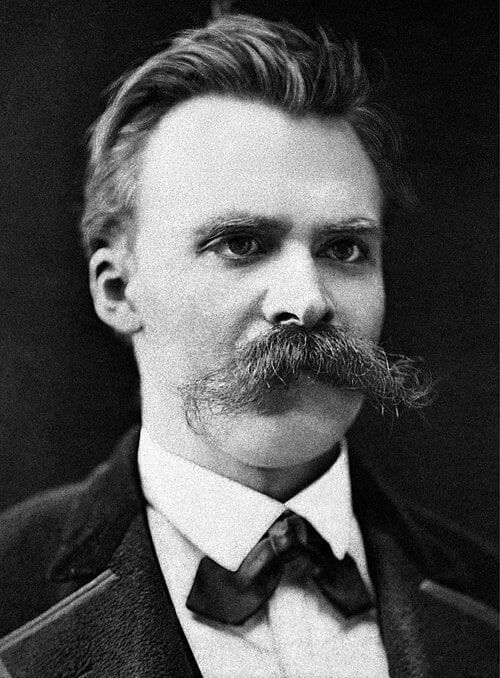 Nietzsche around 1875, photograph by F. Hartmann — public domain
These circulate widely under the same name, but don’t hold up:
Nietzsche challenged traditional morality, introduced the Übermensch, and emphasized the will to power. His lessons inspire individuals to create meaning and embrace strength.
Friedrich Nietzsche on Wikipedia · Stanford Encyclopedia: Nietzsche · Nietzsche: life and ideas