Banner: Rumi with his disciple Husam al-Din Chelebi, an Ottoman-era miniature from the 1590s — painted three centuries after his death; no likeness from life survives.
Jalal al-Din Muhammad Rumi was born in 1207 in the region of Balkh, in present-day Afghanistan. His father, Baha al-Din Walad, was a respected scholar and preacher. When Rumi was a boy the family left, moving west ahead of the Mongol invasions, and eventually settled in Konya, in Anatolia — then the land of “Rum”, which gave him his name. He succeeded his father as a teacher of Islamic law and theology.
In 1244 Rumi met Shams of Tabriz, a wandering dervish. The friendship that followed was so intense that it turned the respected scholar into a poet of ecstatic love. Rumi’s students resented Shams, who left, returned, and around 1247 vanished for good. Rumi’s grief and search for him poured into thousands of poems, many signed with Shams’s name rather than his own.
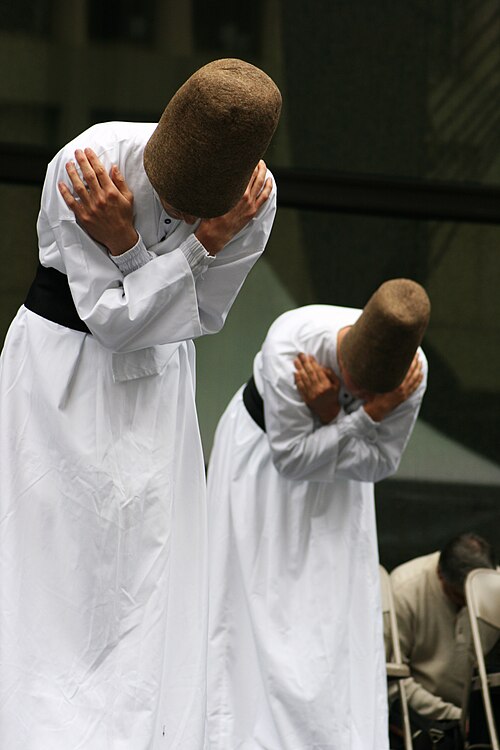 Quinn Dombrowski, CC BY-SA 2.0
“Listen to the reed how it tells a tale, complaining of separations.”Masnavi I.1, tr. R. A. Nicholson
Rumi’s great work, the Masnavi, is a vast poem of some 25,000 couplets in six books, dictated to his disciple Husam al-Din Chelebi. It opens with a reed flute lamenting that it was cut from its reed-bed: the soul’s longing for the God it came from. Its stories, jokes and parables are woven around the Qur’an and Sufi teaching.
“Every one who is left far from his source wishes back the time when he was united with it.”Masnavi I.4, tr. R. A. Nicholson
His other major collection, the Divan-e Shams-e Tabrizi, gathers his lyric poems.
For Rumi, love is both the way and the goal. The ache of separation is not something to escape but the very force that draws the soul home.
“Whether love be from this side or from that side, in the end it leads us yonder.”Masnavi I.111, tr. R. A. Nicholson
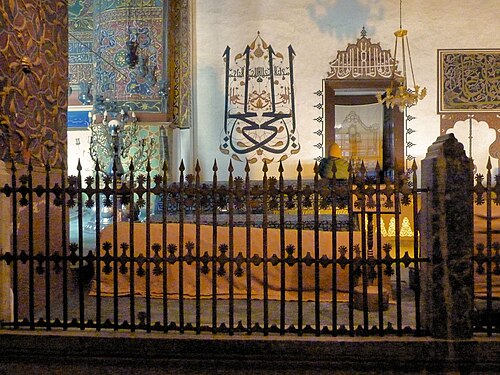 Casalmaggiore Provincia, CC BY-SA 3.0
After his death in 1273, his son Sultan Walad organised his followers into the Mevlevi order, known in the West as the “whirling dervishes” for their turning meditation, the sema. Today Rumi is one of the best-selling poets in the United States — largely through Coleman Barks’s free English versions, which are beautiful but loose, and often leave out the Islamic context Rumi lived and wrote in.
“The wound is the place where the Light enters you.” Widely shared as Rumi, but it cannot be traced to his works.
“Love is the bridge between you and everything.” Another popular line with no source in Rumi.