Miyamoto Musashi was born around 1584 in Japan, during the last turbulent years before the country's unification under the Tokugawa shogunate. By his own account, written late in life in his treatise, he fought and won his first duel at just thirteen years old, against an established swordsman named Arima Kihei. From there he became a musha shugyō — a wandering warrior who traveled the country seeking duels against other schools and swordsmen to test and refine his skill.
Musashi is traditionally credited with winning more than sixty duels without a single loss, often against famous rival schools of swordsmanship. His most celebrated encounter was against the swordsman Sasaki Kojirō on the small island of Ganryū in 1612. Musashi arrived deliberately late, unsettling his opponent, and won the duel using a wooden sword he had carved from a boat oar on the way to the fight. He later developed his own school, Niten Ichi-ryū ("Two Heavens, One Style"), built around fighting with a long and a short sword simultaneously.
In his later years, Musashi served as a retainer to regional lords and eventually withdrew to a cave called Reigandō, where he spent his final years writing. The result, completed shortly before his death in 1645, was The Book of Five Rings (Go Rin no Sho) — a treatise on swordsmanship, strategy, timing, and the psychology of combat, organized around the five classical elements of earth, water, fire, wind, and void. Musashi was also a genuinely accomplished painter and calligrapher; his ink paintings, spare and precise in the same way his swordsmanship is described, are still held in Japanese museums today.
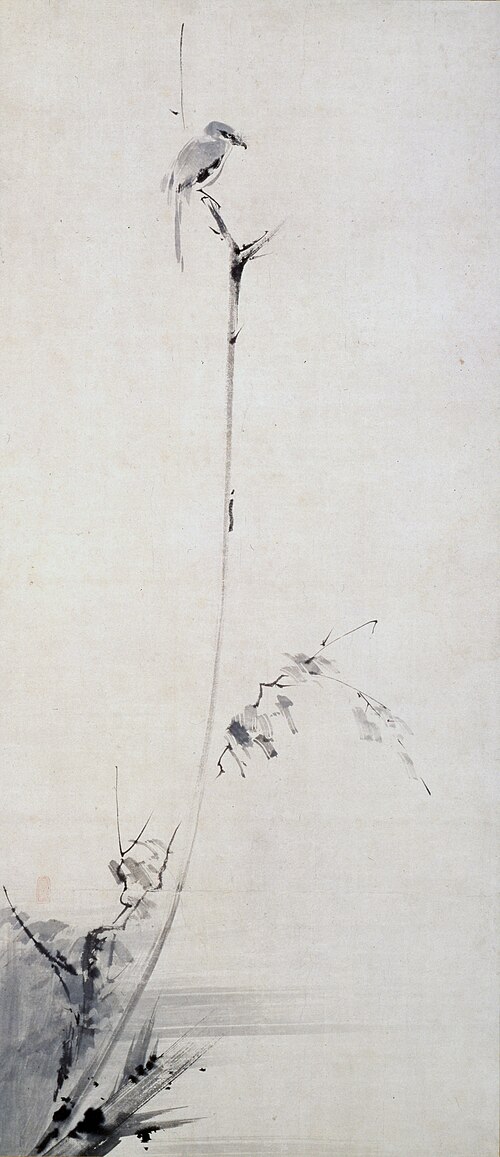 Miyamoto Musashi, Edo period ink painting, public domain
The Book of Five Rings long outlived its original martial context. It is still read today by martial artists, but has also been widely adopted well outside swordsmanship — in business strategy, competitive sport, and negotiation — as a compact study of discipline, adaptability, and reading an opponent. Musashi's principle that mastery comes from stripping away everything unnecessary, captured in his own instruction to "do nothing that is of no use," remains one of the most quoted pieces of practical philosophy to come out of feudal Japan.
Key Figures: Sasaki Kojirō, Arima Kihei
Related Topics: the Niten Ichi-ryū school, samurai culture, Zen and swordsmanship
Miyamoto Musashi on Wikipedia · The Book of Five Rings on Wikipedia · Sun Tzu