Plato was born in Athens around 428/427 BCE into one of the city’s most aristocratic families; his father Ariston claimed descent from Athens’ early kings, and his mother Perictione was related to the lawgiver Solon. A later ancient tradition says his given name was Aristocles and that “Plato” — from the Greek for “broad” — was a nickname. As a young man he expected a career in politics, but two events turned him away from it: the brutal oligarchy of the Thirty Tyrants in 404 BCE, which included his own relatives Critias and Charmides, and then the restored democracy’s trial and execution of his teacher Socrates in 399 BCE.
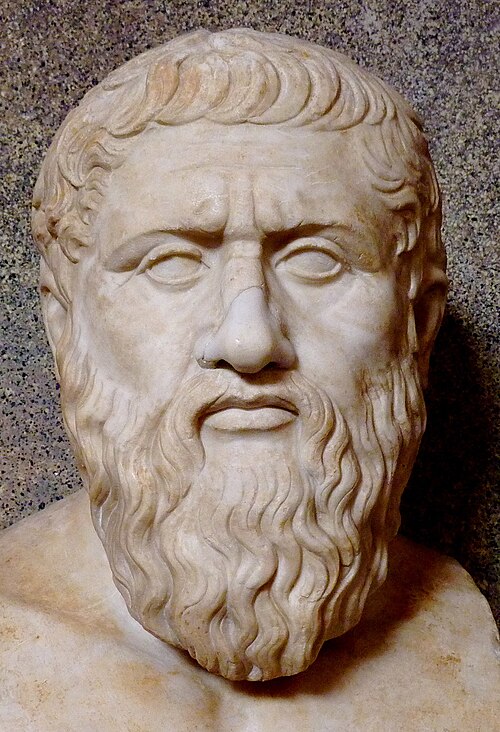 Dudva, CC BY-SA 4.0
Rather than write treatises, Plato wrote dialogues — conversations, most with Socrates as the main speaker. About thirty-five survive, along with thirteen letters of disputed authenticity. Scholars usually group them into early works that portray Socrates questioning his fellow Athenians (Apology, Crito, Euthyphro), middle works where Plato develops his own grand theories (Phaedo, Symposium, Republic), and late works on knowledge, cosmology and law (Theaetetus, Timaeus, Laws). Almost everything we know of Socrates comes through Plato, which makes it hard to say where the teacher ends and the student begins.
Plato’s central idea is that the changing world we see is not the most real thing. Behind every beautiful object stands Beauty itself; behind every just act, Justice itself — perfect, unchanging Forms that the mind can grasp but the senses cannot. His most famous image of this, in Book VII of the Republic, is the allegory of the cave: prisoners chained underground mistake shadows on a wall for reality, until one is freed, climbs into the sunlight, and must then decide whether to go back down and tell the others — who may well kill him for it, as Athens killed Socrates.
The Republic asks what justice is and answers by imagining an ideal city ruled by philosopher-kings, guarded by an educated warrior class and sustained by producers — mirrored in a just soul, where reason governs spirit and appetite. Around 387 BCE Plato founded the Academy in a grove outside Athens, often called the first institution of higher learning in the Western world; Aristotle studied there for about twenty years. Plato also made three journeys to Syracuse in Sicily, hoping to turn its rulers toward philosophy. They went badly — one ancient story even has him sold into slavery and ransomed.
Plato died in Athens around 348/347 BCE, and the Academy he founded continued in various forms for centuries. His influence is hard to overstate: Neoplatonism shaped early Christian theology through Augustine and fed Islamic and Jewish philosophy, and his questions about knowledge, justice and the soul still frame entire fields. In 1929 the philosopher Alfred North Whitehead wrote that the European philosophical tradition “consists of a series of footnotes to Plato.”
Explore more about Plato on Wikipedia.