Socrates was born in Athens around 470 BCE, the son of a stonemason, Sophroniscus, and a midwife, Phaenarete. He served as a hoplite (heavy infantry soldier) in the Peloponnesian War, and was noted by contemporaries for his physical endurance and bravery at the battles of Potidaea, Delium, and Amphipolis. He married Xanthippe, with whom he had three sons, and lived by all accounts a materially modest life, largely indifferent to wealth or comfort, preferring to spend his days in the Athenian agora engaging citizens, politicians, and craftsmen alike in philosophical conversation. Socrates himself wrote nothing; everything we know of him comes secondhand — chiefly from the dialogues of his student Plato, the memoirs of his student Xenophon, and a satirical, unflattering portrait in Aristophanes' comedy The Clouds.
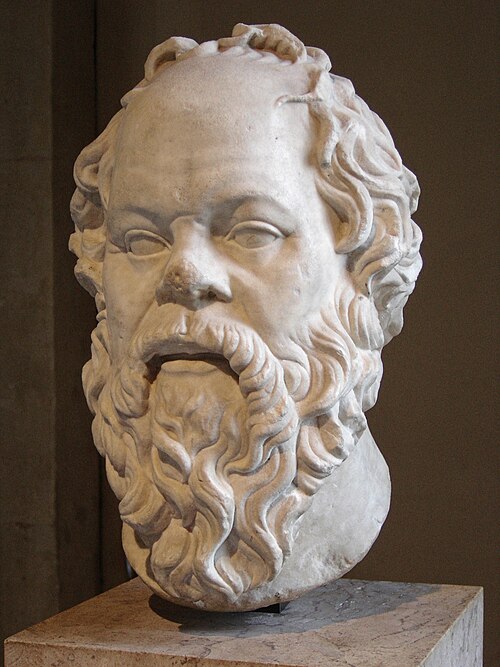 Eric Gaba, CC BY-SA 2.5
Socrates is best known for the method that now bears his name: the Socratic method, or elenchus — a systematic process of questioning that exposes contradictions in a person's beliefs and pushes them toward a clearer, more defensible understanding. He famously claimed to know nothing, treating this admitted ignorance as the necessary starting point for genuine inquiry rather than a weakness. Central to his ethics was the claim that virtue is itself a form of knowledge, and that no one does wrong willingly — people act badly only because they misunderstand what is truly good for them. He also described a personal daimonion, an inner divine voice or sign that warned him away from certain actions, though he insisted it never told him what to do, only what to avoid.
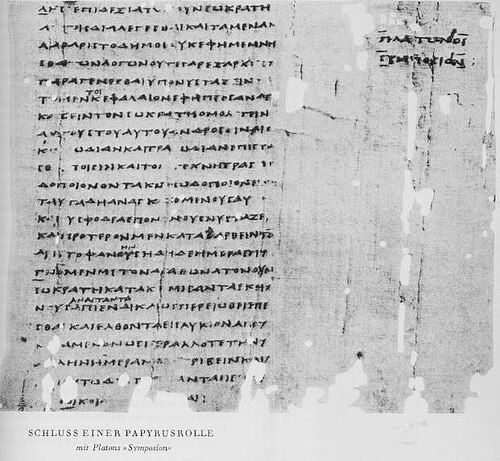 Since Socrates left no writing, everything above comes through students like Plato — papyrus of Plato's Symposium, public domain
In 399 BCE, at around 70 years old, Socrates was tried by an Athenian jury on charges of "corrupting the youth" and "impiety" — failing to recognize the city's official gods. His defense, recorded by Plato in the Apology, refused to renounce his philosophical mission even to save his own life, arguing that "the unexamined life is not worth living." Convicted and sentenced to death, he was given the choice to escape into exile but chose instead to accept the sentence, drinking hemlock in the company of his students. Plato's dialogue the Phaedo records his calm final conversation about the immortality of the soul, making his death one of the most famous scenes in the history of philosophy — a lasting symbol of commitment to one's principles over self-preservation.
Because Socrates left no writings of his own, nearly everything later philosophy inherited from him passed first through Plato, whose dialogues turned Socratic conversation into a literary and philosophical form in its own right. Plato in turn taught Aristotle — together, the three form the foundational sequence of Western philosophy. The Socratic method remains in active use today, particularly in legal education, and his trial and execution continue to be cited in debates over free thought, dissent, and the relationship between the individual and the state.
Explore more about Socrates on Wikipedia.
Read Socrates' Famous Quotes & Lessons →