Aurobindo Ghose was born in Calcutta on 15 August 1872. His father wanted him to be thoroughly English, so he was sent to England at seven and educated at St Paul’s School and King’s College, Cambridge, where he excelled in Greek and Latin. Returning to India in 1893, he worked for the state of Baroda, learned Sanskrit and Indian languages, and was drawn into the movement for independence.
By 1906 he was one of its boldest voices, calling for complete freedom from British rule in the paper Bande Mataram. In 1908 he was arrested in the Alipore bomb case and spent a year in jail awaiting trial — a year he later described as a turning point, when he experienced the Divine everywhere around him. He was acquitted in 1909.
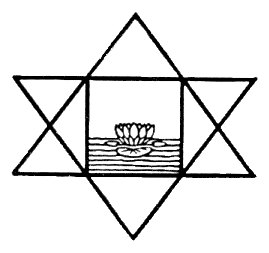 Designed by Sri Aurobindo, 1920, public domain
In 1910 he withdrew from politics and settled in Pondicherry, then a French territory, to devote himself to yoga. There he developed what he called Integral Yoga. Its aim is not to escape the world, but to transform it: human consciousness, he believed, is still evolving, and can rise towards a higher, divine consciousness he called the supermind — bringing a “divine life” down into ordinary earthly existence.
“All life is Yoga.”Sri Aurobindo, The Synthesis of Yoga, Introduction
His closest collaborator was Mirra Alfassa, a Frenchwoman his followers call “the Mother”. From 1926 she led the community that became the Sri Aurobindo Ashram, while he withdrew into seclusion to write. After his death she founded Auroville (1968), an experimental international township near Pondicherry.
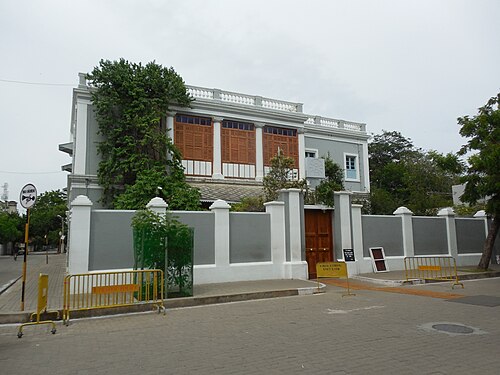 Aravind Sivaraj, CC BY-SA 3.0
His major works include The Life Divine, a philosophy of spiritual evolution; The Synthesis of Yoga, which draws together the paths of knowledge, works and devotion; and Savitri, an epic poem of some 24,000 lines that he revised for decades. He died on 5 December 1950.
At the heart of The Life Divine is a bold idea: evolution is not finished. Matter evolved life, life evolved mind, and mind, Aurobindo argued, is not the last step. Spirit has “involved” itself in matter, and is slowly unfolding back out of it.
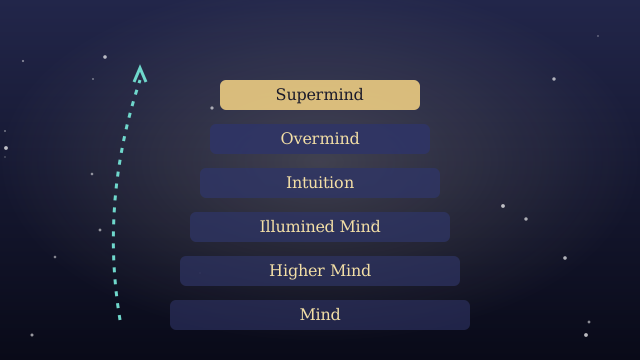 Illustration: the ladder of consciousness, from mind to supermind
He mapped the next stages as a ladder of higher consciousness: Higher Mind, Illumined Mind, Intuition and Overmind, rising to the Supermind, a truth-consciousness that knows things directly rather than by piecing ideas together. The goal is not to escape into this higher state, but to bring it down to transform ordinary human life.
Integral Yoga has no fixed set of techniques. Aurobindo drew on the yogas of knowledge, devotion and work, and treated the whole of life as the field of practice. In his short book The Mother (1928) he summed up the inner attitude in three words: aspiration, a steady call toward the Divine; rejection, refusing the movements of ego, fear and desire; and surrender, offering everything to a higher power to work through.
He described a threefold change: a psychic transformation, as the soul hidden behind the heart comes forward to guide life; a spiritual one, as higher consciousness descends; and finally a supramental transformation of mind, life and even body.
Aurobindo's longest work is Savitri, an epic in blank verse of some 24,000 lines. It retells a story from the Mahabharata: the princess Savitri marries Satyavan knowing he is destined to die within a year, follows Death when he comes for her husband, and argues with him until she wins Satyavan back. In Aurobindo's hands the tale becomes a myth of the human soul confronting death and ignorance and transforming them. He worked on it for more than thirty years, revising it until the last months of his life.
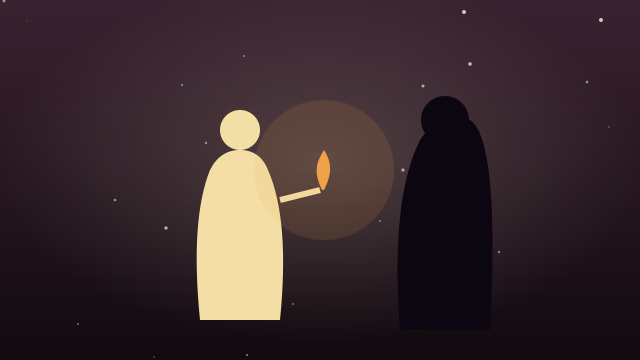 Illustration: Savitri confronts Death to win back Satyavan
On 24 November 1926, a day his followers call the Day of Siddhi, Aurobindo said he had realised the Overmind consciousness. Afterwards he withdrew almost entirely, seeing only a few disciples and answering thousands of letters, while the Mother ran the ashram.
India’s Independence Day falls on his birthday, 15 August — a coincidence he remarked on in his message for that day in 1947. He is remembered both as a founder of Indian nationalism and as one of the most ambitious spiritual philosophers of the 20th century.