Mysticism runs through almost every religion. Here's a map through it.
Mysticism is the search for a direct, first-hand encounter with ultimate reality — God, Brahman, the Dao, emptiness — rather than knowing about it through doctrine or report. The word comes from the Greek mystes, an initiate of the ancient mystery cults, who was sworn to keep silent about what the rites revealed.
Almost every religion has a mystical current running beneath its public form: Sufism in Islam, Kabbalah in Judaism, the contemplatives of Christianity such as Meister Eckhart and Teresa of Ávila, the Upanishads and bhakti saints of India, Buddhist meditation, and the Daoism of Laozi and Zhuangzi.
Do all these mystics experience the same thing? The psychologist William James, in The Varieties of Religious Experience (1902), listed four marks they share: the experience can't be put into words, it feels like knowledge rather than mere feeling, it doesn't last, and it seems to happen to the person rather than being done by them. Aldous Huxley's The Perennial Philosophy (1945) argued that one truth lies under every tradition. Many later scholars, notably Steven Katz, disagree: they argue that what a mystic experiences is shaped by the teachings and expectations they bring to it.
A tantric painting of the subtle body: in many traditions the mystic journey runs inward
Mystics don't all aim at the same thing, and the differences matter:
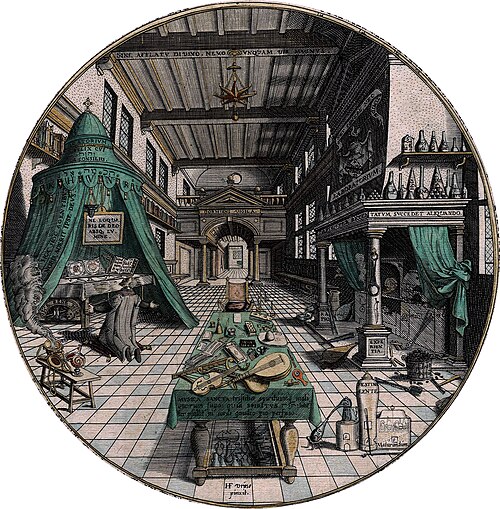
An alchemist's laboratory, 1595 — for many practitioners, transforming base metal into gold was a metaphor for purifying the soul
Because the experience is said to be beyond words, mystics have developed two opposite ways of talking about it. The negative way describes the divine only by saying what it is not: around 500 CE the writer known as Pseudo-Dionysius taught that God is beyond every name, and the 14th-century English Cloud of Unknowing tells its reader to reach God through a “cloud” in which all knowledge is set aside. The positive way piles up images instead — light, fire, the beloved, the ocean — knowing each falls short.
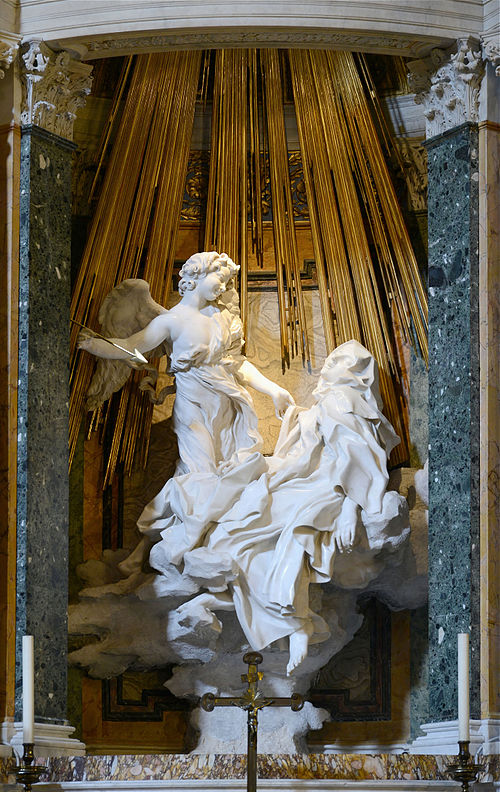
Bernini's Ecstasy of Saint Teresa (1652), depicting the mystical rapture she described in her own writing
Photo: Alvesgaspar, CC BY-SA 4.0
Some mystics report visions and rapture. Teresa of Ávila described an angel piercing her heart with a fiery spear, leaving her “all on fire with a great love of God”, the moment Bernini later carved in marble. Others distrusted such experiences. Zen teachers warn students not to cling to visions, and the 8th-century Chinese layman Pang Yun said his miraculous powers were simply carrying water and chopping wood. For many traditions, the proof of mystical life is not ecstasy but how a person lives afterwards.
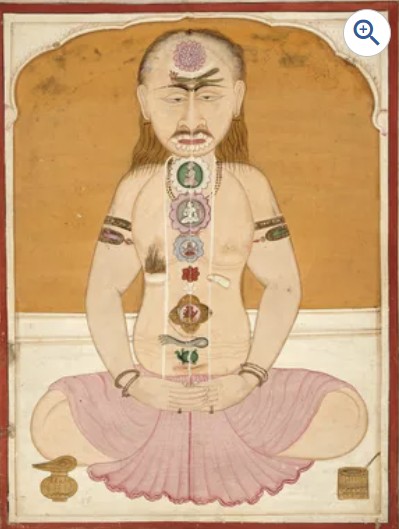
Tantrika painting of the chakras in the body
India has produced perhaps the richest variety of mystical paths, layered over three thousand years.
The Rig Veda already wonders at what lies beyond the gods. Its “Hymn of Creation” (10.129) asks how the world began and ends with a famous shrug: perhaps even the one who watches over it from the highest heaven does not know.
The Upanishads turn the search inward. Their central discovery is that the self at the core of a person is the same as Brahman, the ground of everything, summed up in sayings like tat tvam asi, “you are that” (Chandogya Upanishad 6.8.7).
Patanjali's Yoga Sutras offer a method rather than a theology: still the movements of the mind (1.2), and consciousness can rest in its own nature. Their eight limbs lead from ethics and posture through concentration to samadhi, complete absorption.
From the Tamil poet-saints of the 6th to 9th centuries to Kabir, Mirabai and Chaitanya, the bhakti movement made the path a love affair with God, open to anyone regardless of caste or gender, and sung in everyday languages rather than Sanskrit.
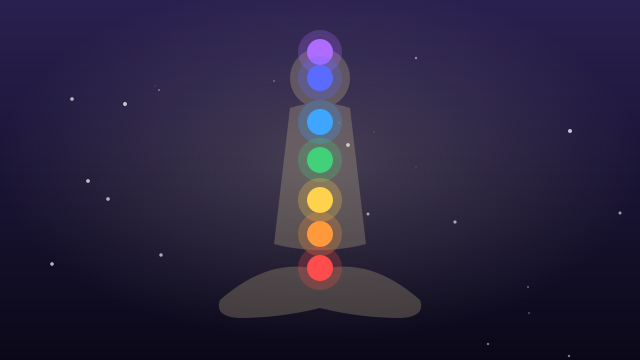
The subtle body and its energy channels
Tantra treats the body itself as the place of awakening. Its maps of the subtle body describe channels (nadis) and centres (chakras) through which a dormant energy, kundalini, is said to rise from the base of the spine to the crown, where the union of Shiva and Shakti is realised.
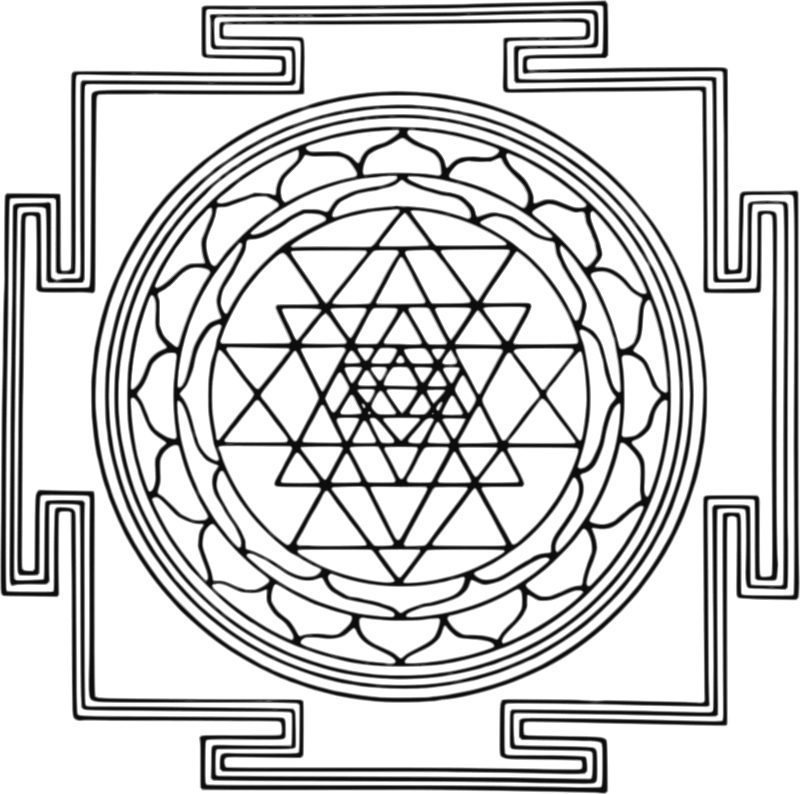
The Sri Yantra — nine interlocking triangles used as a focus for Tantric meditation
N.Manytchkine, CC BY-SA 3.0
Diagrams like the Sri Yantra give the mind a single, intricate object to rest on, and mantras do the same with sound: both are tools for gathering scattered attention into one point.
Nine traditions of mystical practice, each with its own methods and aims. Click any one to read the full story.
Beyond the postures widely practiced in the West today, Yoga's original goal was liberation (moksha) through Patanjali's eight progressive limbs.
Treats the body itself as a sacred instrument, raising the subtle energy kundalini through the chakras toward union with pure consciousness.
Among the oldest mystical practices, using trance, drumming, and plant medicine to travel to other realms and heal on behalf of a community.
Astrology, tarot, and the I Ching share a premise: that the cosmos and the self are patterned in ways that can be read for guidance.
Far more than early chemistry, alchemy framed the transformation of base metal into gold as a metaphor for purifying the soul.

Rooted in texts attributed to Hermes Trismegistus, teaching "as above, so below" — the human microcosm mirrors the divine macrocosm.
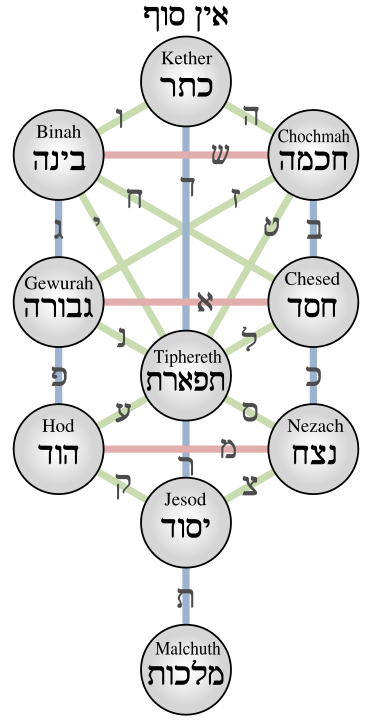
Jewish mysticism's esoteric tradition, centered on the Tree of Life — ten sefirot connected by 22 paths back toward their divine source.

A modern revival of nature reverence formalized in mid-20th-century England, centered on seasonal festivals and a God and Goddess.

Founded in 1875 by Helena Blavatsky, synthesizing Western esotericism with Hindu and Buddhist concepts like karma and reincarnation.
Want the documented history behind the legends? The site's Unsolved Mysteries & Esoteric History hub separates what's actually recorded about secret societies, lost texts, and ancient symbols from what's later myth-making.
Stanford Encyclopedia: Mysticism · William James, The Varieties of Religious Experience · The mystics on this site